
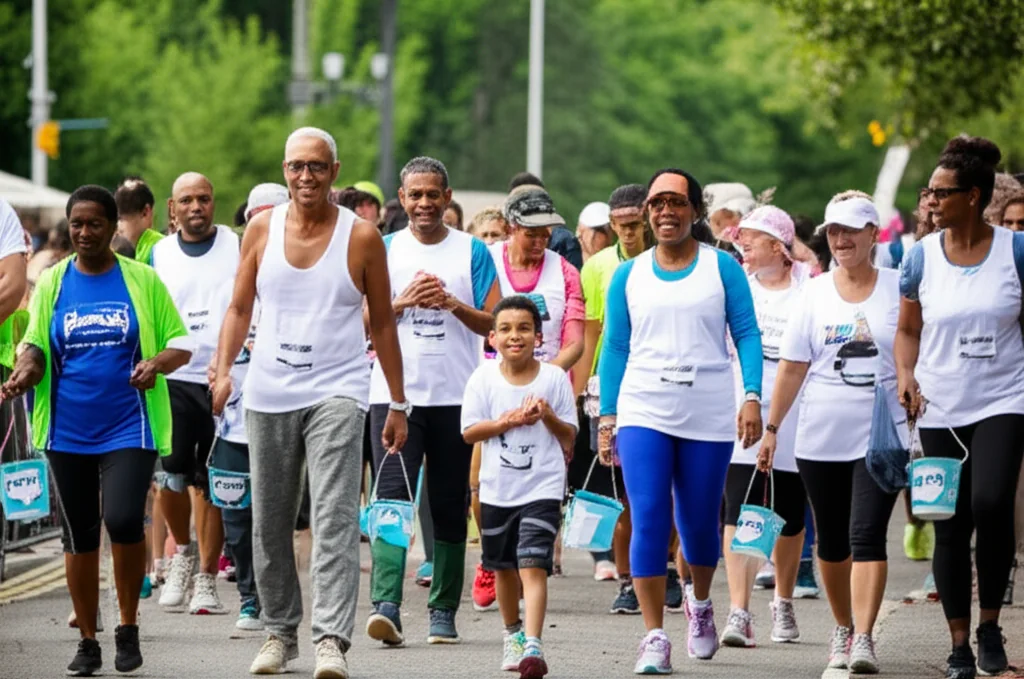

The perfect walkathon distance isn’t a one-size-fits-all number; it’s a 1-mile loop for kids, a 5K for adults, and a gentle 2-mile stroll for seniors. Getting the walkathon distance by age group right is the single most critical factor in ensuring your event is safe, fun, and financially successful.
Imagine a 6-year-old sweating through a 5K while their 80-year-old grandparent tries to keep up, or a group of teens bored to tears by a half-mile lap. We’ve seen it happen, and it’s a fundraising disaster waiting to occur.
Did you know that the first modern charity walkathon in 1953 covered a staggering 80 miles? Today, we know that sustainability beats endurance every time. By tailoring the distance to the participant’s developmental stage, you maximize participation and minimize the risk of injury.
Key Takeaways
- Tailor the Distance: Todlers need 0.25 miles, elementary kids thrive on 1 mile, tens can handle 2–3 miles, and adults stick to the standard 5K.
- Safety is Paramount: Always adjust routes for accessibility and enforce strict supervision ratios for children under 10.
- Engagement Drives Donations: A fun, achievable distance keeps participants smiling, which directly correlates to higher pledge collection rates.
- Flexibility Wins: Offer multiple route options (e.g., a “Challenge Loop” and a “Fun Loop”) to accommodate varying fitness levels within the same age group.
Table of Contents
- ⚡️ Quick Tips and Facts
- 📜 A Brief History of the Walkathon: From Charity Strolls to Global Phenomena
- 👶 The Ultimate Guide to Walkathon Distance by Age Group
- 1. Todlers and Preschoolers (Ages 2–5): The Crawl, Walk, and Run Phase
- 2. Elementary School Kids (Ages 6–10): Building Stamina and Fun
- 3. Twens and Early Teens (Ages 1–14): Finding Their Stride
- 4. Teens and Young Adults (Ages 15–18): The Competitive Edge
- 5. Adults (Ages 19–64): The Standard 5K and Beyond
- 6. Seniors (Ages 65+): Walking for Wellness and Wisdom
- 🗺️ How to Determine the Perfect Walkathon Distance and Route
- ⏱️ Setting Time Limits and Pacing Strategies for Every Age
- 🚦 Starting Line Protocol: Managing the Chaos with Grace
- 👨 👩 👧 👦 Participant Age and Supervision Requirements: Keeping Little Feet Safe
- ♿ Accessibility Considerations: Ensuring Everyone Can Join the Walk
- 🛡️ Prioritizing Safety and Fairness: Rules That Protect Your Event
- 📝 The Essential Walkathon Waiver: What You Need to Know
- 💰 Fundraising 101: P2P Crowdfunding, Auctions, and More
- Peer-to-Peer (P2P) Crowdfunding Strategies
- Virtual and In-Person Auctions
- Golf Tournaments and Charity Games
- Online Stores and Ticketing
- Sweepstakes, Raffles, and Direct Donations
- 🏛️ Legal and Regulatory Compliance: Registration, Insurance, and Donors
- Confirm Your Fundraising Platform is Registered
- Purchase Event Insurance
- Register as a Charitable Solicitor
- Understanding Minimum Donation Regulations
- 🤔 10 Walk-a-Thon Fundraiser FAQs + How to Get Started
- 🏆 Why DoJigy is the Leader in Walk-a-Thon Software
- Raise Funds Faster with Our Free, Donor-Friendly Fundraising Platform
- Create a Free Account and See How We Can Help Your Organization Smash Your Fundraising Goals!
- 📚 Recommended Links
- 📖 Reference Links
- 🏁 Conclusion
⚡️ Quick Tips and Facts
Before you lace up those sneakers and start plotting a route that could make a marathon runner sweat, let’s hit the pause button. You might be wondering, “Is there a magic number for how far my 7-year-old should walk?” or “Can my 80-year-old aunt join the 5K without turning into a human pretzel?” The short answer? It depends, but we’ve got the cheat sheet right here.
At Walkathon Benefits™, we’ve seen everything from toddlers taking their first wobbly steps to octogenarians setting personal bests. Here are the non-negotiables you need to know before you even think about the starting line:
- The Golden Rule of Distance: There is no single “standard” distance. While 5K (3.1 miles) is the industry standard for adults, children often thrive on 1-mile loops, and seniors might prefer a 2K scenic stroll.
- Safety First, Fundraising Second: A walkathon that ends in an ambulance ride is a fundraising disaster. Supervision ratios are critical for kids under 10.
- The “Fun” Factor: If the kids are bored, the parents are bored. If the parents are bored, the donations dry up. Engagement is just as important as elevation.
- Hydration Stations: You can’t walk on empty. Plan a water stop every 1 to 1.5 miles, regardless of the total distance.
- The Pledge Math: Remember, the distance determines the pledge. If a kid walks 1 mile and a donor pledges $5/mile, that’s $5. If they walk 5 miles, that’s $25. Keep the distance achievable to ensure maximum participation and fewer “I didn’t finish” regrets.
For a deep dive into how these distances impact health outcomes, check out our guide on walkathon distance.
📜 A Brief History of the Walkathon: From Charity Strolls to Global Phenomena

You might think walkathons are a modern invention born from the era of Fitbits and Strava, but the roots go back much further than your smartphone’s battery life. The concept of the “walkathon” is actually a portmanteau of “walk” and “marathon,” but its origins are a bit more… theatrical.
In the 1930s, dance marathons were all the rage. People would dance for days to win cash prizes. As the Great Depression hit, these evolved into endurance walks. But the modern charity walkathon we know today? That credit goes to Ramón Rivero (also known as Diplo) in 1953 in San Juan, Puerto Rico. He organized a walk to raise money for the Liga Puertoriqueña Contra el Cáncer. He walked from San Juan to Ponce—a staggering 80 miles—and raised the equivalent of $85,0 in today’s money! 🇵🇷
Fast forward to 1968, and the American Freedom from Hunger Foundation brought the concept to the US mainland in Minneapolis. Thanks to a little push from Johnny Carson and Ed McMahon on The Tonight Show, the idea exploded. By 1971, over 150,0 Americans participated in coordinated walks, raising over $1.2 million.
Why does this history matter to you? Because it proves that flexibility has always been the secret sauce. Whether it was an 80-mile trek or a 3-mile school fundraiser, the goal was always to mobilize the community. Today, we’ve moved away from the “endurance at all costs” mentality to a health-focused, inclusive approach. We don’t want people walking until they collapse; we want them walking until they smile.
👶 The Ultimate Guide to Walkathon Distance by Age Group
So, you’ve decided to host an event. The big question hangs in the air like a fogy morning: How far should they walk?
If you ask a dozen event planners, you’ll get a dozen different answers. Some say “5K for everyone!” while others scream “1 mile for the kids!” The truth, as we’ve learned from years of organizing events, is that one size definitely does not fit all.
Let’s break down the optimal distances by age group, blending medical advice with real-world event logistics.
1. Todlers and Preschoolers (Ages 2–5): The Crawl, Walk, and Run Phase
Let’s be honest: asking a 3-year-old to walk a measured distance is like asking a goldfish to climb a tree. They are adorable, chaotic, and their attention spans are measured in seconds.
- Recommended Distance: 0.25 to 0.5 miles (40m – 80m).
- The Strategy: Don’t measure it in miles; measure it in fun. Create a “loop” that takes about 15–20 minutes to complete.
- The Reality: They will stop to pet a dog, pick up a leaf, or run in circles. That’s okay! The goal is exposure, not endurance.
- Supervision: 10% mandatory. One adult per child, or a very tight group ratio (1:3).
Pro Tip: Use a “stroller-friendly” route. Many parents will bring their little ones in strollers, and a flat, paved path is a must.
2. Elementary School Kids (Ages 6–10): Building Stamina and Fun
This is the sweet spot! Kids in this age group have developed the motor skills to walk a measured distance, but they still need constant engagement. They are the workhorses of many school fundraisers.
- Recommended Distance: 1 mile (1.6 km).
- Why 1 Mile? It’s a round number, easy to calculate pledges ($1/mile, $5/mile), and achievable for a 45-minute activity.
- Engagement: Break the mile into four 0.25-mile segments with “checkpoints” (e.g., a dance party, a water station, a sticker station).
- Pacing: They will sprint at the start and drag at the end. Time limits are less important than completion.
3. Twens and Early Teens (Ages 1–14): Finding Their Stride
Ah, the awkward phase. They are too cool for the “kiddie” 1-mile walk, but not quite ready for the grueling 5K. This group is often the most competitive.
- Recommended Distance: 2 to 3 miles (3.2 – 4.8 km).
- The Challenge: Offer a “Challenge Loop” of 3 miles and a “Fun Loop” of 2 miles. Let them choose their own adventure.
- Social Aspect: This age group walks in packs. Ensure the route allows for group walking without blocking the path for others.
- Safety: While they are more independent, supervision is still required, especially if the route leaves school grounds.
4. Teens and Young Adults (Ages 15–18): The Competitive Edge
These are the high school athletes, the runners, and the social leaders. They can handle the standard 5K, and many will want to run it.
- Recommended Distance: 5K (3.1 miles).
- The Vibe: Treat this like a mini-race. Have a start gun, a finish line banner, and maybe even a “fastest walker” category.
- Fundraising: This group is great at peer-to-peer fundraising. They can easily hit their goals if the distance feels “legit.”
- Caution: Watch out for over-exertion. Encourage warm-ups!
5. Adults (Ages 19–64): The Standard 5K and Beyond
The backbone of any walkathon. Adults are used to the 5K distance. It’s the gold standard for charity walks.
- Recommended Distance: 5K (3.1 miles) is the default.
- Variations: Offer a 10K (6.2 miles) option for the serious walkers, but keep the main event at 5K to ensure high participation.
- Inclusivity: Remember, not all adults are runners. Some are walking for a cause, some for fitness, and some just for the free t-shirt. All are welcome.
6. Seniors (Ages 65+): Walking for Wellness and Wisdom
Seniors are a vital part of the community, and their participation adds heart to any event. However, their needs are different.
- Recommended Distance: 1 to 2 miles (1.6 – 3.2 km).
- The Approach: Focus on comfort and safety. Flat terrain is non-negotiable.
- Pacing: No time limits! Let them walk at their own pace.
- Support: Have “sweper” volunteers at the back to ensure no one is left behind.
| Age Group | Recommended Distance | Duration (Est.) | Supervision Level | Key Focus |
|---|---|---|---|---|
| Todlers (2-5) | 0.25 – 0.5 miles | 15-20 mins | High (1:1) | Fun & Safety |
| Elementary (6-10) | 1 mile | 30-45 mins | High (1:5) | Engagement |
| Twens (1-14) | 2 – 3 miles | 45-60 mins | Moderate | Choice & Social |
| Tens (15-18) | 5K (3.1 miles) | 45-60 mins | Low | Competition |
| Adults (19-64) | 5K (3.1 miles) | 45-60 mins | Self | Community |
| Seniors (65+) | 1 – 2 miles | 30-60 mins | Moderate | Wellness |
🗺️ How to Determine the Perfect Walkathon Distance and Route
You’ve got the age groups sorted, but now you need a route. This is where many organizers stumble. A beautiful route that is too hilly or has too many traffic crossings is a recipe for disaster.
Step 1: Map It Out (Literally)
Don’t guess. Use tools like Google Maps or Strava to plot your route.
- Measure the exact distance. A “1-mile” route that is actually 1.2 miles can confuse pledge calculations.
- Check the elevation. A 1-mile route with a 20-foot hill is much harder than a flat 1-mile route.
Step 2: The “Stroller and Wheelchair” Test
Is the route accessible?
- Surface: Paved or hard-packed gravel is best. Avoid grass, mud, or coblestones.
- Width: Can two strollers pass each other? Can a wheelchair turn around?
- Restrooms: Are there portable toilets or public restrooms along the route?
Step 3: Safety First
- Traffic: If you must cross roads, do you have the manpower to stop traffic? If not, choose a park loop.
- Shade: In the summer, a sunny 5K can be dangerous. Look for tree-lined paths.
- Water: Can you place water stations every mile? If not, shorten the distance.
Did you know? According to the Centers for Disease Control and Prevention (CDC), walking is one of the most accessible forms of physical activity, but environmental barriers like lack of sidewalks are a major deterrent. Learn more about safe walking environments.
⏱️ Setting Time Limits and Pacing Strategies for Every Age
Time limits are the unsung heroes of event management. Without them, your awards ceremony turns into a waiting game, and your volunteers get exhausted.
The “Sweper” Strategy
Never let a participant get left behind. Have a “sweper” team (usually on bikes or in a slow vehicle) that follows the last walker.
- For Kids: The sweper ensures no child wanders off.
- For Seniors: The sweper offers a ride if they get tired.
Setting the Clock
- Kids (1 mile): 45 minutes max. If they aren’t done by then, they get a “participation medal” and a ride back.
- Adults (5K): 90 minutes. This allows for a leisurely pace (18 min/mile) plus time for photos.
- The “Cutoff” Rule: Be clear in your registration: “The course closes at [Time].” This manages expectations.
Pacing Tips
- Start Slow: Advise participants to start at a “conversational pace.”
- The “Walk/Run” Method: For mixed-ability groups, encourage walking intervals.
- Music: A playlist at the start line can set the energy.
🚦 Starting Line Protocol: Managing the Chaos with Grace
The starting line is where the magic happens, but it’s also where chaos reigns. You have 50 people, 20 dogs, and 50 strollers all trying to get to the front.
The “Wave” Start
Instead of letting everyone go at once (which causes bottlenecks), use waves:
- Wave 1: Wheelchairs and strollers (5 mins before start).
- Wave 2: Seniors and families with young kids.
- Wave 3: Teens and adults.
- Wave 4: The “runers” (if you have a competitive element).
The “Bib” Check
Make sure everyone has their bib number pinned on. This is crucial for timing and safety.
- Tip: Use safety pins, not tape. Tape hurts when you take it off!
The Countdown
Build the hype!
- “10 seconds to go!”
- “Remember to smile for the cameras!”
- “Let’s do this for [Cause]!”
👨 👩 👧 👦 Participant Age and Supervision Requirements: Keeping Little Feet Safe
We touched on this earlier, but let’s get specific. Supervision is the number one rule for kids’ events.
The Ratios
- Ages 2-5: 1 adult per child. No exceptions.
- Ages 6-10: 1 adult per 5 children.
- Ages 1-14: 1 adult per 10 children (or group leaders).
- Ages 15+: Self-supervised, but a “headcount” is recommended.
The “Buddy System”
For older kids, implement a buddy system. Pair them up so they are responsible for each other.
- Rule: “You don’t leave your buddy behind.”
Emergency Protocols
- Identification: Kids should wear a wristband with their parent’s phone number.
- Meeting Point: Designate a “Lost Child” tent with a clear sign.
- Communication: Volunteers should have radios or a group text chain.
♿ Accessibility Considerations: Ensuring Everyone Can Join the Walk
A walkathon that excludes people with disabilities is a walkathon that has failed its mission. Inclusivity is not just a buzzword; it’s a requirement.
Route Accessibility
- Width: Minimum 6 feet wide for two wheelchairs to pass.
- Slope: Max 5% grade for long distances.
- Surface: No cracks, no loose gravel, no grass.
Support Services
- Accessible Restrooms: Ensure portable toilets have ramps.
- Shuttle Service: For those who can’t walk the full distance but want to participate.
- Sign Language Interpreters: For the deaf community.
Fact: The Americans with Disabilities Act (ADA) requires public events to be accessible. Read more about ADA compliance.
🛡️ Prioritizing Safety and Fairness: Rules That Protect Your Event
You want a fun event, but you also want to protect your organization from lawsuits. Safety and fairness go hand in hand.
The Rules of the Road
- No Running: For kids’ events, running can lead to falls. Make it a “walking only” event.
- No Pets (Unless Service Animals): Dogs can trip people.
- No Bikes: Unless it’s a specific “walk/bike” event.
Fairness in Fundraising
- Pledge Consistency: Ensure everyone understands the pledge structure ($/mile vs. flat donation).
- Distance Verification: How do you prove they walked the distance?
Option A: Checkpoints with stamps.
Option B: GPS tracking apps (like Strava).
Option C: Self-reporting (with a trust but verify system).
📝 The Essential Walkathon Waiver: What You Need to Know
You cannot skip this. A waiver is your legal shield. It protects your organization if someone trips, falls, or gets hurt.
What to Include
- Assumption of Risk: Participants acknowledge the risks of walking.
- Release of Liability: They agree not to sue your organization.
- Medical Consent: Permission to treat them in an emergency.
- Photo Release: Permission to use their photos for marketing.
Digital vs. Paper
Digital waivers are the way to go. They are faster, easier to store, and harder to lose. Platforms like Smartwaiver or DoJigy make this seamless.
Warning: Never let a minor participate without a parent/guardian signature.
💰 Fundraising 101: P2P Crowdfunding, Auctions, and More
Now that the walking is sorted, let’s talk about the money. How do you turn those steps into dollars?
Peer-to-Peer (P2P) Crowdfunding Strategies
This is the bread and butter of walkathons.
- How it works: Participants create a personal page and ask friends/family for pledges.
- The Hook: “I’m walking 5K for [Cause]. Will you sponsor me $5/mile?”
- Tools: Use platforms like DoJigy, 9Pledges, or Classy to automate the process.
Virtual and In-Person Auctions
- Silent Auctions: Great for post-walk gatherings.
- Live Auctions: High energy, high revenue.
- Items: Gift baskets, gift cards, experiences.
Golf Tournaments and Charity Games
- Add-ons: If you have a golf course nearby, host a “Walk & Golf” event.
- Games: Cornhole, face painting, or a “mud run” for the brave.
Online Stores and Ticketing
- Merch: Sell t-shirts, water bottles, and hats.
- Spectator Tickets: Charge a small fee for non-walkers to watch and cheer.
Sweepstakes, Raffles, and Direct Donations
- Raffles: “Buy a ticket for $5, win a $10 gift card.”
- Direct Donations: For those who can’t walk but want to give.
🏛️ Legal and Regulatory Compliance: Registration, Insurance, and Donors
The boring stuff that keeps you out of jail. Don’t skip this!
Confirm Your Fundraising Platform is Registered
If you use a platform like DoJigy or 9Pledges, check that they are registered in your state. Some states require the platform to be registered as a charitable solicitor.
Purchase Event Insurance
General Liability Insurance is a must. It covers accidents, injuries, and property damage.
- Cost: Usually a few hundred dollars for a one-day event.
- Provider: Look for Hiscox or The Hartford.
Register as a Charitable Solicitor
In many states, you must register with the Attorney General’s office before soliciting donations.
- States: Requirements vary. Check your state’s requirements.
Understanding Minimum Donation Regulations
Some states have minimum fundraising thresholds before you can keep the money.
- Example: If you raise less than $50, you might have to return the funds.
- Policy: Be clear about what happens if a participant doesn’t meet their goal. Do they have to pay the difference?
🤔 10 Walk-a-Thon Fundraiser FAQs + How to Get Started

You’ve got questions? We’ve got answers. Here are the top 10 FAQs we get at Walkathon Benefits™.
- How do I choose the right distance?
Answer: Base it on your primary demographic. If it’s a school event, 1 mile. If it’s a community 5K, stick to 3.1 miles. - What if it rains?
Answer: Have a rain date or a virtual option. Don’t cancel; adapt! - How do I get sponsors?
Answer: Reach out to local businesses. Offer them logo placement on t-shirts or the website. - Do I need a permit?
Answer: Yes, if you’re using public roads or parks. Contact your city’s parks and recreation department. - How do I handle medical emergencies?
Answer: Have an EMT on site and a clear plan for calling 91. - What about dogs?
Answer: Check local laws. Many parks allow dogs on leashes, but some events ban them for safety. - How do I track pledges?
Answer: Use software like DoJigy or 9Pledges. Manual tracking is a nightmare. - Can I have a “fun run” and a “serious run”?
Answer: Absolutely! Offer different start times or waves. - What’s the best time of year?
Answer: Spring and Fall. Avoid the heat of summer and the cold of winter. - How do I promote the event?
Answer: Social media, local newspapers, schools, and community boards.
🏆 Why DoJigy is the Leader in Walk-a-Thon Software
Let’s be real: organizing a walkathon is hard. Doing it with pen and paper is impossible. That’s why we recommend DoJigy.
Features That Make a Difference
- Automated Waivers: No more paper piles.
- Real-time Tracking: See who is raising money as it happens.
- Customizable Pages: Make it look like your event.
- Mobile Friendly: Participants can fundraise from their phones.
The “Free” Factor
DoJigy offers a free tier for small events, which is a game-changer for schools and small nonprofits.
Quote from a User: “DoJigy saved us hours of work. We could focus on the cause, not the paperwork.” – Sarah J., Event Organizer
Comparison: DoJigy vs. Others
| Feature | DoJigy | 9Pledges | Classy |
|---|---|---|---|
| Free Tier | ✅ Yes | ✅ Yes | ❌ No |
| Waiver Automation | ✅ Yes | ✅ Yes | ✅ Yes |
| Mobile App | ✅ Yes | ✅ Yes | ✅ Yes |
| Custom Branding | ✅ Yes | ✅ Yes | ✅ Yes |
| Support | 24/7 | Business Hours | Business Hours |
👉 CHECK PRICE on:
- DoJigy: DoJigy Official Website | DoJigy on Amazon
- 9Pledges: 9Pledges Official Website | 9Pledges on Amazon
🏁 Conclusion
So, there you have it. From the wobbly steps of a toddler to the steady stride of a senior, walkathon distance by age group is all about finding the sweet spot between challenge and fun.
Remember, the goal isn’t to break records; it’s to build community, raise funds, and get people moving. Whether you’re planning a 1-mile school walk or a 5K community event, the key is preparation, safety, and flexibility.
Did we answer your burning questions? We hope so! But if you’re still wondering about the perfect route for your specific group, remember: start small, test the waters, and always prioritize the well-being of your participants.
Now, go out there and make some steps count! 🚶 ♀️🚶 ♂️
📚 Recommended Links
Ready to get started? Here are some tools and resources to help you plan the perfect event.
- Fundraising Software:
DoJigy: DoJigy Official Website
9Pledges: 9Pledges Official Website - Event Insurance:
Hiscox: Hiscox Event Insurance
The Hartford: The Hartford Event Insurance - Books on Fundraising:
The Fundraising Handbook by Amazon
Walkathon Planning Guide by Amazon - Safety Gear:
Reflective Vests: Amazon Reflective Vests
First Aid Kits: Amazon First Aid Kits
📖 Reference Links
- Centers for Disease Control and Prevention (CDC): Physical Activity Basics
- Americans with Disabilities Act (ADA): ADA Compliance
- National Council of Nonprofits: Charitable Solicitation Laws
- DoJigy Blog: Walkathon Rules and Regulations
- 9Pledges: Walk-a-Thon Fundraiser FAQs
- Wikipedia: Walkathon History
🤔 FAQs on Walkathon Rules and Regulations

What is the average walkathon distance for adults in different age brackets?
For adults (19-64), the standard is 5K (3.1 miles). For seniors (65+), the distance is often reduced to 1-2 miles to accommodate varying fitness levels.
Are there specific distance guidelines for teenagers participating in charity walks?
Yes. Teens (15-18) can handle the full 5K, while twens (1-14) are often better suited for 2-3 miles to keep it engaging without being overwhelming.
How does walkathon distance vary for seniors over 65?
Seniors typically walk 1 to 2 miles. The focus is on safety, comfort, and social interaction rather than speed or distance.
What is the recommended walkathon distance for children under 12?
Children under 12 should walk 0.5 to 1 mile. For toddlers (2-5), a 0.25-mile loop is ideal.
Is there a standard walkathon distance for teenagers?
While there’s no strict “standard,” 5K is common for high schoolers, and 2-3 miles is common for middle schoolers.
What are the average walkathon distances for adults by age?
- 19-40: 5K
- 41-60: 5K
- 61+: 1-2 miles
What is the ideal walkathon distance for teenagers?
3 miles is a great middle ground for teenagers, offering a challenge without the intensity of a full 5K.
Are there shorter walkathon options for beginners?
Absolutely! 1-mile or 2K events are perfect for beginners, seniors, and young children.
How does walkathon distance vary for seniors?
Seniors usually opt for shorter distances (1-2 miles) with plenty of rest stops and flat terrain.
How do walkathon distances vary by age group for health benefits?
- Kids: Short distances (0.5-1 mile) for fun and motor skill development.
- Tens: Moderate distances (2-3 miles) for stamina.
- Adults: 5K for cardiovascular health.
- Seniors: 1-2 miles for mobility and social connection.
What is the ideal walkathon distance for adults?
5K (3.1 miles) is the ideal distance for most adults, balancing challenge and accessibility.
How far should teenagers walk in a walkathon event?
2 to 3 miles is recommended for teenagers, depending on their fitness level and the event’s focus.
What is the recommended walkathon distance for children?
0.5 to 1 mile is the recommended distance for children, ensuring they stay engaged and safe.