
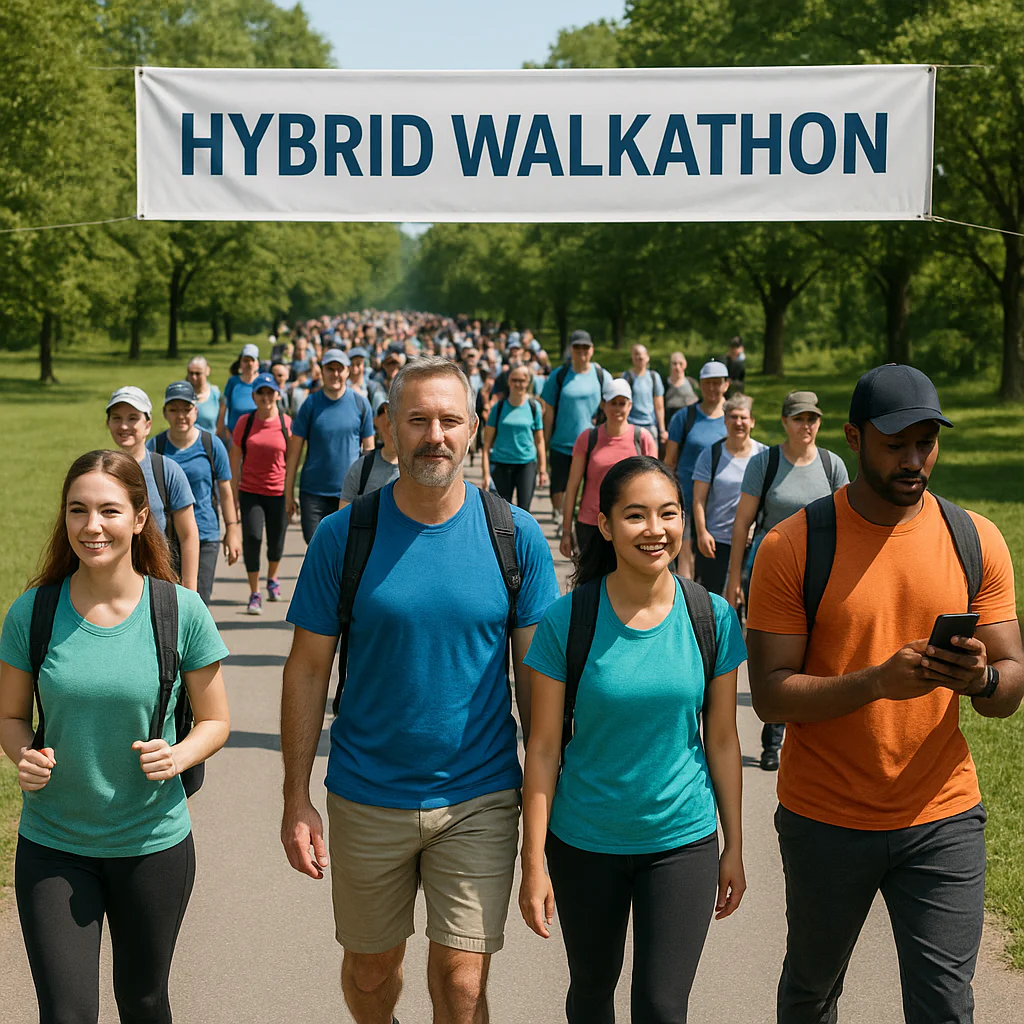
Remember the days when a walkathon meant gathering at dawn, rain or shine, hoping everyone showed up? We at Walkathon Benefits™
certainly do! While those traditional strides hold a special place in our hearts, the world of fundraising and fitness has evolved, and with it, the walkathon. We’ve seen firsthand how blending the tangible energy of an in-person event with
the boundless accessibility of virtual participation can double your reach and shatter fundraising goals. But how do you orchestrate such a dynamic event without feeling like you’re planning two separate galas at once? Don’t worry, we’ve got
you covered! Dive in as we unveil the most effective hybrid walkathon models and share our expert best practices to ensure your next event isn’t just successful, but truly unforgettable.
Key Takeaways
- Hybrid walkathons blend
in-person and virtual elements to maximize reach, inclusivity, and fundraising potential, offering flexibility for all participants. - There are diverse hybrid models like “Split-Path” (in-person hubs + remote routes)
and “Challenge-Based” (gamified engagement), allowing customization for your cause. - Robust technology is crucial for seamless registration, activity tracking, virtual engagement, and communication across both participant groups.
- Engagement
strategies must cater to both audiences, using interactive virtual elements, gamification, and opportunities for cross-interaction to foster a unified community. - Careful planning, clear communication, and dedicated teams are essential to navigate the logistical
complexities and ensure a high-quality experience for everyone.
Table of Contents
-
🚶 ♀️ The Evolution of Walkathons: From Traditional Strides to Hybrid Horizons
-
Understanding Hybrid Walkathon Models: A Blended Approach to Fundraising and Fitness
-
Types of Hybrid Walkathon Models: Blending In-Person and Virtual Experiences
-
4. The “Community-Centric” Model: Localized Hybrid Experiences
-
✅ The Upsides of Going Hybrid: Why Blended Events Win Hearts and Funds
-
❌ Navigating the Hurdles: Challenges in Hybrid Walkathon Planning and Execution
-
Crafting a Winning Hybrid Walkathon Strategy: Essential Elements for Success
-
Setting Clear Goals and Participant Expectations for Your Blended Event
-
Choosing the Right Technology for Seamless Hybrid Integration
-
Designing Engaging In-Person and Virtual Experiences That Connect
-
Effective Communication: Keeping Every Participant in the Loop
-
Sponsorships and Fundraising in a Hybrid Landscape: New Opportunities
-
Implementing Your Hybrid Walkathon: A Step-by-Step Guide to Best Practices
-
3. Develop Engaging Content and Challenges for All Participants
-
4. Create a Robust Communication Plan for Pre, During, and Post-Event
-
7. Execute and Adapt: The Event Day Experience for Hybrid Walkathons
- Inspiring Hybrid Walkathon Success Stories: Real-World Examples and Lessons Learned
- The “Charity Miles” Approach: App-Driven Hybridity for Everyday Movement
- “St. Jude Walk/Run”: Blending Local Events with Nationwide Virtual Participation
- “Susan G. Komen Race for the Cure”: Adapting to Hybrid Formats for Maximum Reach
- Essential Tech Toolkit for Your Hybrid Walkathon: Platforms and Gadgets
- Virtual Event Platforms (e.g., RunSignup, GiveSignup, Strava, Zoom)
- Registration and Fundraising Software: Streamlining Your Operations
- Wearable Tech Integration: Enhancing the Participant Experience
- Maximizing Participant Engagement: Tips for a Memorable Hybrid Event
- Gamification and Leaderboards: Fueling Friendly Competition
- Interactive Virtual Elements: Beyond Just Tracking Steps
- Local Meet-ups and Community Building: Fostering Connections
- Personalized Experiences: Making Every Participant Feel Valued
- Navigating Logistics and Ensuring Safety in Hybrid Walkathons
- Permits and Regulations for In-Person Components: What You Need to Know
- Health and Safety Protocols: Prioritizing Participant Well-being
- Managing Swag and Participant Kits: Delivering Delight to All
- Conclusion: The Future is Hybrid for Walkathons – Step into Success!
- Recommended Links
- Reference Links
⚡️ Quick Tips and
Facts: Your Hybrid Walkathon Cheat Sheet
Alright, fellow fitness fanatics and fundraising champions! We at Walkathon Benefits™ have seen it all, from sunny strolls to virtual sprints, and let us tell you, the **hybrid walkathon
** is where the magic truly happens. It’s not just a trend; it’s a revolution in how we walk, connect, and raise those much-needed funds! So, before we dive deep, here are some quick, punch
y facts and tips to get your brain buzzing:
-
What is it? A hybrid walkathon seamlessly blends in-person participation with virtual engagement, offering the best of both worlds. Think of it as a choose
-your-own-adventure for charity! -
Why go hybrid? Massive reach! You’re no longer limited by geography, weather, or even busy schedules. More participants mean more impact and more funds for
your cause. -
Engagement is Key: Virtual attendees need just as much love (if not more!) as your in-person crowd. Think interactive challenges, live leaderboards, and shout-outs!
-
Tech is Your Best Friend: From registration platforms to activity trackers, reliable technology is the backbone of a successful hybrid event. Don’t skimp here!
-
Flexibility Wins: Offer various ways to participate.
Some folks love the camaraderie of a group walk, while others prefer a solo stride on their favorite trail. Cater to both! -
Data-Driven Decisions: Hybrid events offer a treasure trove of data – from registration trends to engagement metrics.
Use it to make your next event even better! -
Start Small, Dream Big: If it’s your first hybrid rodeo, consider a simpler model. You can always scale up once you’ve nailed
the basics. -
Community First: Whether virtual or in-person, foster a sense of belonging. That’s what keeps people coming back!
Ready to lace up and learn how to make
your next walkathon an unforgettable hybrid success? Let’s get walking!
🚶
♀️ The Evolution of Walkathons: From Traditional Strides to Hybrid Horizons
Remember the good old days? We’d gather at the crack of dawn, maybe in a local park or a designated route, all wearing our matching t-
shirts, ready to pound the pavement for a cause. Those traditional walkathons were, and still are, fantastic for building local community spirit and providing a tangible sense of accomplishment. We’ve certainly had our share of memorable moments, like the time our
team at Walkathon Benefits™ helped organize a walk where a local celebrity unexpectedly joined, boosting morale (and donations!) through the roof!
Then came the digital age, and with it, the rise of virtual walkathons. Suddenly, you
could participate from anywhere – your treadmill, your neighborhood, even a scenic mountain trail. This opened up incredible opportunities for fundraising strategies [https://www.walkathonbenefits.com/category/fundraising-strategies/] and reaching
a global audience. We saw organizations connect with supporters across continents, proving that distance is no match for dedication.
But something was still missing, wasn’t it? The virtual events, while convenient, sometimes lacked that palpable energy, that
shared physical experience that makes traditional events so special. And the in-person events, while vibrant, often left out those who couldn’t travel, had scheduling conflicts, or simply preferred to participate on their own terms.
Enter the hybrid walk
athon – the ultimate evolution! It’s like the perfect blend of your favorite smoothie: all the goodness of the in-person experience mixed with the incredible accessibility and flexibility of virtual participation. It’s about creating a “phygital experience
,” as some experts call it, where the physical and digital seamlessly intertwine. This innovative approach allows us to maximize community engagement [https://www.walkathonbenefits.com/category/community-engagement/] and
truly democratize participation, ensuring no one is left out of the stride for a good cause. It’s not just about adapting; it’s about innovating and expanding our horizons!
Understanding Hybrid Walkathon Models: A Blended Approach to Fundraising and Fitness
So, what exactly is a hybrid walkathon model
? Imagine this: you’re planning a fantastic event to support a cause close to your heart. Instead of choosing either an in-person gathering or a purely virtual challenge, you decide to do both, simultaneously or sequentially
, creating a rich, inclusive experience for everyone. That, my friends, is the essence of a hybrid walkathon. It’s a strategic fusion that leverages the best aspects of both worlds to amplify your impact on health benefits of walking
[https://www.walkathonbenefits.com/category/health-benefits-of-walking/] and fundraising goals.
At its core, a hybrid walkathon acknowledges that people have different preferences, schedules, and geographical locations. It’
s about offering flexibility and choice, which are powerful motivators for participation. As Timothy Skennion, Managing Director of Derabo Advisory Group, wisely puts it, “Hybrid events create new and measurable opportunities to enhance the attendee experience
and drive increased value for sponsors – opportunities that are limited at purely live or digital events.” We couldn’t agree more!
Think of it as building a bridge between two islands: one where people gather physically
, sharing high-fives and collective energy, and another where participants connect digitally, tracking their progress, sharing stories, and feeling part of something bigger, no matter where they are. This blended approach isn’t just about convenience; it’
s about maximizing reach, boosting fundraising potential, and creating a more sustainable event model that can adapt to unforeseen circumstances. It also provides a wealth of data that’s often difficult to capture offline
, giving you invaluable insights into engagement and participant behavior.
Whether you’re aiming to raise funds for a local animal shelter or a global health initiative, a hybrid model allows you to tap into a broader base
of support, making your walkathon more resilient and impactful than ever before. It’s about creating a truly accessible and engaging experience for every single step taken.
Types of Hybrid Walkathon Models: Blending In-Person and Virtual Experiences
The beauty of hybrid walkathons lies in their versatility! There’s no one-size-fits
-all, which means you can tailor your event to perfectly fit your cause, audience, and resources. We’ve seen some incredibly creative approaches, and here at Walkathon Benefits™, we’re always excited to explore new ways to get
people moving. Here are some popular and effective hybrid walkathon models we’ve encountered, each offering a unique blend of in-person and virtual elements:
1. The “Split-Path” Model: In-Person Hubs &
Remote Routes
This model is fantastic for organizations with a strong local presence but also a desire to reach a wider audience. Imagine a central, designated in-person walkathon route in a city park or community center. Simultaneously, participants
from anywhere else in the world can register and complete their walk virtually on their own chosen routes.
- How it works:
- In-person participants gather at a specific location and time, enjoying
the traditional camaraderie, start/finish line festivities, and perhaps local entertainment. - Virtual participants track their miles using apps like Strava or MapMyRun (more on tech later!), submitting their progress to a
central leaderboard. - Benefits: Offers the best of both worlds – local community spirit and global reach.
- Considerations: Requires careful coordination for both physical logistics and virtual tracking.
2. The “Time
-Shift” Model: Flexible Participation Windows
Life gets busy, right? This model acknowledges that not everyone can commit to a specific date or time. Instead, it offers a flexible window for participation, often spanning a week or even a
month.
- How it works:
- You might designate a specific “kick-off” event that’s either in-person or virtual.
- Participants then have a set period (e.g., “Walk for a Week!”) to complete their desired distance at their own pace, whenever and wherever it suits them.
- A grand “wrap-up” event, again, either in-person or virtual, can celebrate achievements
. - Benefits: Maximizes participation by accommodating diverse schedules. Great for encouraging consistent physical fitness tips [https://www.walkathonbenefits.com/category/physical-fitness-tips/].
- Considerations:
Maintaining engagement over a longer period requires consistent communication and motivation.
3. The “Challenge-Based” Model: Gamified Hybrid Engagement
Who doesn’t love a good challenge? This model injects an element of gam
ification into your hybrid walkathon, making it incredibly engaging for both virtual and in-person participants.
- How it works:
- Beyond just walking, participants might earn points for completing specific challenges (e.g., “Walk 5 miles in a new park,” “Recruit a friend,” “Share your progress on social media”).
- Teams can compete against each other, and leaderboards track progress for both individual and team challenges.
In-person elements could include “challenge stations” along the route, while virtual participants complete them remotely.
- Benefits: Boosts motivation, encourages social sharing, and creates a fun, competitive atmosphere.
Considerations:** Requires a robust platform to manage challenges, points, and leaderboards.
4. The “Community-Centric” Model: Localized Hybrid Experiences
This model focuses on empowering smaller, localized groups to host their own
mini-walkathons while still being connected to a larger, overarching virtual event.
- How it works:
- A main organization provides the virtual platform, branding, and fundraising tools.
- Local ”
captains” or community leaders organize smaller, in-person group walks in their respective areas. - All participants, whether in a group or walking solo, contribute to the same virtual leaderboard and fundraising goal.
- Benefits: F
osters strong local community bonds while benefiting from the scale of a larger event. Excellent for expanding reach without massive central logistical overhead. - Considerations: Requires strong leadership and coordination at the local level.
5. The “Remote
-First with Optional In-Person” Model
This model prioritizes the virtual experience, making it the primary mode of participation, but offers optional in-person gatherings for those who desire them.
-
How it works:
-
The event is designed primarily as a virtual challenge, with all core activities (registration, tracking, fundraising, communication) happening online.
-
Organizations might offer a few smaller, optional in-person meet-ups or group
walks in key locations, perhaps at the beginning or end of the event period. -
Benefits: Highly accessible and scalable, reducing the logistical complexity of a large central in-person event.
-
Considerations: The
virtual experience must be exceptionally engaging to keep participants motivated without a strong in-person anchor.
Each of these models offers a unique pathway to a successful hybrid walkathon. The key is to choose the one that best aligns with your organization’s goals,
resources, and, most importantly, the preferences of your amazing participants!
✅
The Upsides of Going Hybrid: Why Blended Events Win Hearts and Funds
If you’re still on the fence about embracing the hybrid model for your next walkathon, let us, the seasoned pros at Walkathon Benefits™, tell you
why it’s a game-changer. We’ve seen firsthand how blending in-person energy with virtual accessibility can truly elevate an event, making it more impactful, inclusive, and, frankly, more fun!
Here’s why going hybrid is
a winning strategy:
-
Expanded Reach and Inclusivity: This is perhaps the biggest win! Traditional walkathons are limited by geography. Virtual events break those barriers, and hybrid events combine the best of both. You can engage
participants from across the street or across the globe! This means more people can support your cause, regardless of their location, physical abilities, or schedule constraints. Imagine a grandparent in another state walking alongside their grandchild virtually, both contributing to the same
goal! -
Increased Fundraising Potential: More participants naturally lead to greater fundraising strategies [https://www.walkathonbenefits.com/category/fundraising-strategies/]. With a wider audience, you open the
door to more donations, more peer-to-peer fundraising, and more opportunities for corporate sponsorships. Plus, the extended timeline often associated with hybrid models (more on that later!) gives participants more time to solicit donations. -
Flex
ibility and Convenience for Participants: Life is unpredictable! A hybrid model offers unparalleled flexibility. Participants can choose to join the main event, walk on their own schedule, or even combine both. This reduces barriers to entry and makes it easier for busy
individuals and families to participate, ultimately boosting overall numbers. -
Enhanced Data Collection and Insights: Purely in-person events often leave us guessing about engagement metrics. Hybrid events, especially with robust virtual platforms, provide a treasure trove of data.
You can track registrations, fundraising progress, participant activity (steps, miles), engagement with virtual content, and even demographic information. This data is invaluable for understanding your audience, measuring success, and refining future events. -
Sustainability and Reduced Environmental Impact: By offering a virtual component, you inherently reduce the need for travel, large-scale physical infrastructure, and printed materials. This contributes to a smaller carbon footprint, aligning with growing environmental consciousness. As
the ExpoPlatform summary notes, global road transport activity fell nearly 50% during lockdowns, a trend hybrids support. It’s a win for your cause and a win for the planet!
Resilience and Adaptability:** The past few years have taught us the importance of being adaptable. A hybrid model provides built-in resilience. If unforeseen circumstances (like weather, public health concerns, or travel restrictions) impact your in-person component
, your virtual event can still proceed, ensuring your fundraising efforts aren’t completely derailed.
- Innovative Engagement Opportunities: Hybrid events are a “blank canvas for reinventing the event experience,” according to Timothy Skennion. You can get incredibly creative with virtual challenges, interactive leaderboards, live-streamed content, and digital badges. This keeps participants engaged and excited, whether they’re physically present or joining from afar.
We’ve seen organizations
double their participant numbers and significantly exceed their fundraising goals by embracing the hybrid approach. It’s not just about adding a virtual component; it’s about strategically designing an event that truly connects with everyone, everywhere.
❌ Navigating the Hurdles: Challenges in Hybrid Walkathon Planning and Execution
While the benefits of hybrid walk
athons are undeniably compelling, let’s be real: they’re not without their challenges. As experts who’ve guided countless organizations through these waters, we at Walkathon Benefits™ know that a smooth hybrid event requires careful planning and a proactive
approach to potential pitfalls. It’s like trying to juggle flaming torches while riding a unicycle – exhilarating, but you need to know what you’re doing!
Here are some common hurdles you might encounter and our candid thoughts on how to tackle
them:
- The “Two Events in One” Trap: This is perhaps the biggest misconception. Many organizers mistakenly think they’re just running one event with two access points. In reality, you’re essentially planning two distinct
experiences – one for your in-person attendees and one for your virtual participants – that need to be seamlessly integrated. This means double the planning, double the communication, and often, double the resources. - Our Take
: Don’t underestimate the workload. Allocate dedicated teams or individuals to manage the in-person and virtual components, ensuring both receive equal attention and a high-quality experience. - Technology Overload and Glitches: From registration platforms to activity
trackers, live streaming, and virtual engagement tools, the tech stack for a hybrid event can be complex. Technical issues can quickly derail participant experience and frustrate organizers. - Our Take: Invest in reliable technology and conduct
rigorous dry runs. “Production values must be ‘top-notch’ to immerse virtual attendees,” comparable to a “big-budget Netflix movie.” Test everything, and have a dedicated tech support team (or at least a very tech-savvy volunteer!) on standby. We’ve all been on a Zoom call where someone’s mic isn’t working – multiply that by hundreds of participants, and you get the picture! - Maintaining Engagement for Virtual
Participants: It’s easy for virtual attendees to feel like second-class citizens if they’re just watching a live stream without interaction. Keeping them engaged and feeling connected to the main event and the cause is a significant challenge.
Our Take:** This is where creativity shines! Think interactive Q&A sessions, virtual photo booths, live leaderboards, gamification, and dedicated virtual hosts. The goal is to make them feel like active participants, not just passive observers.
- Bridging the In-Person/Virtual Divide: How do you foster a sense of shared community when some people are physically together and others are dispersed? It can be tricky to create meaningful interactions between the two groups.
Our Take: Design activities that encourage cross-pollination. For example, a virtual participant could send a message that’s displayed on a screen at the in-person event, or in-person groups could send video messages to the
virtual community. Use social media hashtags to unite everyone under one digital roof.
-
Logistical Complexity: Managing permits, venues, volunteers, and safety protocols for an in-person event, while simultaneously coordinating virtual platforms, swag distribution, and technical
support for remote participants, can be a logistical nightmare. -
Our Take: Start planning early, create detailed checklists, and don’t be afraid to delegate. Clear guidelines for both in-person and virtual participation are crucial.
-
Sponsorship Value Proposition: Convincing sponsors that a hybrid event offers equivalent or even superior value can be a hurdle. They might be used to traditional branding opportunities.
-
Our Take: Highlight the expanded reach, increased
data insights, and diverse engagement opportunities that hybrid events offer. Showcase how their brand can be seen by both physical and digital audiences.
Navigating these challenges requires foresight, flexibility, and a willingness to learn and adapt. But trust
us, the rewards – in terms of reach, impact, and funds raised – are well worth the effort!
Crafting a Winning Hybrid Walkathon Strategy: Essential Elements for Success
Alright, you’re convinced! Hybrid is the way to go. But how do you move from enthusiasm to execution? Crafting a winning hybrid walkathon strategy
is like building a sturdy bridge – it requires a solid foundation, careful planning, and attention to every detail. At Walkathon Benefits™, we believe a well-thought-out strategy is the bedrock of an unforgettable and impactful event. Let’s lay
down those essential elements!
Setting Clear Goals and Participant Expectations for Your Blended Event
Before you even think about platforms or routes, ask yourself: What do we want to achieve? Is it primarily about fundraising? Raising awareness?
Building community? A combination?
- Define Your “Why”: Clearly articulate your fundraising target, participant numbers, and engagement goals. This “why” will guide every decision you make.
- Segment Your Goals: You
might have different goals for your in-person versus virtual participants. For example, aiming for a higher donation average from virtual participants due to lower overhead costs, or focusing on local community building for your physical event. - Communicate Expectations
: Be crystal clear with participants about what a hybrid event entails. Explain how both in-person and virtual components work, what they can expect, and how their participation contributes to the overall goal. Transparency builds trust and avoids confusion.
Choosing the Right Technology for Seamless Hybrid Integration
Technology isn’t just a tool; it’s the nervous system of your hybrid walkathon. Selecting the right platforms is paramount for a smooth experience.
- Unified
Registration System: Look for a platform that can handle both in-person and virtual registrations seamlessly. This simplifies data management and provides a single source of truth for participant information. Platforms like RunSignup or GiveSignup are excellent choices,
offering comprehensive event management, fundraising tools, and participant tracking. - Activity Tracking Integration: How will virtual participants track their miles? Consider apps that integrate easily with your main platform, such as Strava or MapMy
Run. Ensure clear instructions are provided on how to connect these. - Virtual Engagement Hub: This could be a dedicated event app, a custom webpage, or even a private Facebook group. It’s where virtual participants access content
, view leaderboards, connect with others, and get updates. - Live Streaming Capabilities: If you plan to broadcast elements of your in-person event (like the kick-off or closing ceremony), you’ll need reliable
live streaming. Zoom Events or YouTube Live are popular options. - Payment Processing: Secure and easy payment processing is non-negotiable for donations and registration fees. PayPal and Stripe are widely used
and trusted.
We’ll dive deeper into specific tech recommendations in a later section, but remember: test, test, test!
Designing Engaging In-Person and Virtual Experiences That Connect
This is where the magic happens – creating experiences that make
everyone feel valued and connected, regardless of their participation mode.
- The “Wow” Factor for In-Person: Think beyond just a walk. What unique elements can you add? A fun warm-up, local entertainment, healthy
snacks, or a vibrant finish line celebration? - Interactive Virtual Content: Don’t just broadcast! Encourage interaction.
- Live Q&A sessions: Use a platform’s Q&A feature to allow
both in-person and virtual attendees to submit questions, as highlighted by David Maldow in the first YouTube video [cite: #featured-video]. This creates a unified experience and makes everyone feel heard. - Virtual Em
cees: A dedicated virtual host can engage remote participants, read out their comments, and make them feel part of the live action. - Polls and Quizzes: Keep virtual attendees active and thinking.
Virtual Photo Booths: Encourage participants to share photos with event-specific filters.
-
Shared Challenges: Create challenges that both groups can participate in, like a collective mileage goal or a scavenger hunt (with virtual clues for remote participants).
-
Personalized Journeys: Offer different “tracks” or levels of participation to cater to varying fitness levels and interests.
Effective Communication: Keeping Every Participant in the Loop
Communication is the glue that holds your hybrid event together. Without
it, confusion reigns!
- Pre-Event Buzz: Start early! Use email marketing (e.g., Mailchimp), social media, and your website to build excitement, share details, and answer FAQs.
Clear Instructions: Provide detailed guides for both in-person and virtual participants on how to register, track activity, fundraise, and access event content.
- Real-Time Updates: During the event, use push notifications (via an event app), social media, and email to share progress, celebrate milestones, and announce any changes.
- Post-Event Follow-Up: Thank everyone, share results, and provide links to photos and recordings. Keep
the momentum going!
Building a Strong Volunteer Team for Dual Environments
Your volunteers are the unsung heroes of any walkathon, and in a hybrid model, their roles become even more critical and diverse.
- Dedicated Roles
: You’ll need volunteers for traditional in-person tasks (registration, route marshals, water stations) and for virtual roles (tech support, virtual chat moderators, social media engagement). - Training is Key: Ensure
all volunteers are thoroughly trained on their specific roles, the event technology, and how to assist participants from both groups. - Clear Communication Channels: Establish clear ways for volunteers to communicate with each other and with event organizers, especially for
troubleshooting.
Sponsorships and Fundraising in a Hybrid Landscape: New Opportunities
Hybrid events offer a compelling proposition for sponsors, but you need to articulate the value clearly.
- Showcase Expanded Reach: Emphasize that sponsors will gain
exposure to a larger, more diverse audience – both local and global. - Diverse Branding Opportunities: Offer creative sponsorship packages that include both physical branding (banners, t-shirts) and digital branding (logo placement on virtual platforms, social media shout-outs, sponsored challenges).
- Data-Driven Value: Highlight the analytics you can provide to sponsors, demonstrating the reach and engagement their brand received.
- Creative Fundraising Ideas: Explore **walkathon fundraiser ideas
** [https://www.walkathonbenefits.com/walkathon-fundraiser-ideas/] that leverage the hybrid format, such as virtual challenges with sponsor prizes, or matching gift campaigns.
Measuring Success: Key Metrics for Hybrid Walk
athons
How will you know if your hybrid walkathon was a triumph? By tracking the right metrics!
- Registration Numbers: Track both in-person and virtual registrations.
- Fundraising Totals: Monitor overall
funds raised, average donation per participant, and peer-to-peer fundraising success. - Participant Engagement: For virtual participants, track app usage, challenge completion rates, social media mentions, and live stream viewership. For in-
person, observe attendance and feedback. - Website and Social Media Traffic: See how many people are visiting your event pages and engaging with your content.
- Feedback Surveys: Crucial for gathering qualitative data from both groups.
By meticulously planning each of these elements, you’ll be well on your way to hosting a hybrid walkathon that not only meets but exceeds your expectations, leaving a lasting positive impact on your cause and your community.
Implementing Your Hybrid Walkathon: A Step-by-Step Guide to Best Practices
You’ve got your
strategy, your goals are crystal clear, and your team is buzzing with excitement. Now, it’s time to roll up your sleeves and get down to the nitty-gritty of implementation! Think of this as your “Walkathon Benefits™ Blueprint
” for bringing your hybrid vision to life. We’ll walk you through the essential steps, ensuring you’re well-equipped to handle the complexities and celebrate the successes.
1. Define Your Hybrid Model and Target Audience
Before anything
else, solidify which hybrid model you’re adopting (refer back to our “Types of Hybrid Walkathon Models” section!). Are you leaning towards a “Split-Path” with a central hub, or a “Remote-First” approach
with optional meet-ups?
- Clarify Your Model: Document the specifics: dates, duration, in-person locations, virtual participation window, and how the two components will interact.
- Identify Your Audience Seg
ments: Who are you trying to reach? Local community members, national supporters, international advocates? Understanding your audience will inform your marketing, communication, and engagement strategies. For example, if you’re targeting kids walkathons [https://www.walkathonbenefits.com/category/kids-walkathons/], your engagement tactics will differ significantly.
2. Select Your Virtual Platform and In-Person Venues
This is where your tech decisions become tangible, and your physical space
comes into play.
- Virtual Platform Selection: Choose a platform that aligns with your budget, technical capabilities, and desired features. Look for robust registration, fundraising, activity tracking integration, and communication tools.
- Consider
: RunSignup (comprehensive event management), GiveSignup (fundraising focus), or a combination with activity trackers like Strava. For live streaming, Zoom Events or YouTube Live are strong contenders.
In-Person Venue Scouting: If you have a physical component, secure your venue(s) early. Consider factors like capacity, accessibility, amenities (restrooms, water access), and local permits.
3. Develop
Engaging Content and Challenges for All Participants
This is where you inject the fun and motivation!
- Thematic Challenges: Create engaging challenges that resonate with your cause. For example, a “Miles for Meals” walkathon could challenge
participants to walk enough miles to “travel” to a certain number of food banks. - Gamification Elements: Incorporate leaderboards (individual, team, corporate), badges for milestones, and virtual rewards.
- Educational
Content: Share facts about your cause, health benefits of walking [https://www.walkathonbenefits.com/category/health-benefits-of-walking/], or physical fitness tips [https://www.walkathonbenefits.com/category/physical-fitness-tips/] throughout the event period. This keeps participants informed and connected to the “why.” - Interactive Virtual Activities: Plan virtual warm-ups, stretch sessions, or even a virtual DJ
for remote participants.
4. Create a Robust Communication Plan for Pre, During, and Post-Event
Effective communication is paramount for a seamless hybrid experience.
- Pre-Event Hype:
Website/Landing Page:** Your central hub for all event information, registration, and FAQs.
-
Email Campaigns: Use a tool like Mailchimp to send regular updates, training tips, fundraising encouragement, and important
logistical details. -
Social Media Blitz: Engage your audience on platforms like Facebook, Instagram, and LinkedIn with compelling visuals, participant stories, and calls to action. Use a unique hashtag!
-
During-Event Engagement:
-
Real-Time Updates: Use your event app or social media to share live leaderboards, photo highlights, and messages of encouragement.
-
Virtual Check-ins: Host short, live virtual check-ins
to connect with remote participants. -
Dedicated Support: Provide clear channels for participants (both in-person and virtual) to ask questions and get assistance.
-
Post-Event Gratitude & Follow-Up:
-
Thank You Messages: Express sincere gratitude to all participants, volunteers, and sponsors.
-
Impact Report: Share the total funds raised and how they will be used. This reinforces the impact of their efforts.
Surveys: Gather feedback to improve future events.
5. Recruit and Train Your Hybrid Event Team and Volunteers
Your team is your backbone!
- Identify Key Roles: Beyond traditional roles, you’ll
need virtual event managers, tech support, social media moderators, and virtual engagement specialists. - Comprehensive Training: Provide thorough training for all volunteers, covering both in-person duties and virtual platform navigation. Ensure they understand how to assist
both types of participants. - Clear Communication Channels: Establish a clear chain of command and communication methods (e.g., Slack channels for quick updates) for your team during the event.
6. Market Your Event Effectively
Across All Channels
Spread the word far and wide!
- Targeted Marketing: Tailor your marketing messages to appeal to both potential in-person and virtual participants. Highlight the unique benefits of each.
- Leverage Influ
encers: Partner with local fitness influencers, community leaders, or even past participants to help promote your event. - Community Partnerships: Collaborate with local businesses, schools, and community groups to expand your reach.
- SEO
Optimization: Use relevant keywords like “hybrid walkathon,” “virtual charity walk,” and “community fitness event” in your online content to improve discoverability.
7. Execute and Adapt: The Event Day Experience for Hybrid Walkathons
The big day (or week)! This is where all your planning comes to fruition.
- Seamless Check-in/Onboarding: For in-person, have efficient registration. For virtual, ensure easy access to the virtual platform and clear
instructions for activity tracking. - Engage Both Audiences:
- Live Stream Key Moments: Broadcast your opening ceremony, special guest speakers, or awards to your virtual audience.
- Interactive Q
&A: As mentioned earlier, use a unified Q&A feature to allow both in-person and virtual attendees to submit questions, making everyone feel part of the conversation. [cite: #featured-video] - Virtual Shout
-outs: Have your in-person emcee give shout-outs to virtual participants and display their comments or photos on screens. - Troubleshooting: Have a dedicated team ready to address any technical glitches or participant questions promptly.
Flexibility is Key: Be prepared to adapt. Weather changes, technical issues, or unexpected participant needs can arise. A calm, flexible approach will save the day.
8. Post-Event Engagement and Follow-Up: Keeping the Momentum
Going
The event might be over, but your relationship with participants isn’t!
- Prompt Thank Yous: Send personalized thank you emails to all participants, volunteers, and sponsors.
- Share Results and Impact: Publish
a comprehensive recap of the event, including funds raised, participant numbers, and stories of impact. This reinforces the value of their contribution. - Gather Feedback: Send out surveys to both in-person and virtual participants to collect valuable
feedback for future improvements. - Maintain Community: Keep your event community active (e.g., through a Facebook group or newsletter) to nurture relationships and build anticipation for your next event. This is crucial for long-term **
community engagement** [https://www.walkathonbenefits.com/category/community-engagement/].
By following these steps, you’ll not only execute a successful hybrid walkathon but also build a stronger, more engaged community around
your cause.
Inspiring Hybrid Walkathon Success Stories: Real-World Examples and Lessons
Learned
Sometimes, the best way to understand how something works is to see it in action! We at Walkathon Benefits™ love to celebrate the ingenuity of organizations that have embraced the hybrid model and achieved incredible results. These real-world examples aren
‘t just inspiring; they offer invaluable lessons for your own hybrid walkathon journey.
The “Charity Miles” Approach: App-Driven Hybridity for Everyday Movement
While not a single event, the Charity Miles app embodies
the spirit of continuous, app-driven hybrid participation. It allows users to earn money for charity every time they walk, run, or bike, funded by corporate sponsors.
- How it works: Users download the app, choose a charity from
a list (including well-known organizations like Feeding America and the ALS Association), and then simply track their activity. The app leverages GPS and accelerometers to record distance. - Hybrid Lesson: This model demonstrates how
technology can turn everyday activity into a continuous fundraising effort, blurring the lines between a dedicated event and ongoing engagement. It’s “remote-first” with an inherent hybrid nature, as participants are walking in their own physical spaces but contributing to a collective
digital goal. - Key Takeaway: Consider how you can integrate ongoing activity tracking and micro-fundraising into your hybrid model to keep participants engaged beyond a single event day.
“St. Jude Walk/Run”: Bl
ending Local Events with Nationwide Virtual Participation
The St. Jude Walk/Run is a fantastic example of a large-scale hybrid event that successfully combines numerous in-person gatherings with a robust virtual component.
- How it works: St
. Jude Children’s Research Hospital hosts dozens of in-person Walk/Run events in cities across the United States. Simultaneously, individuals and teams can register to participate virtually from anywhere, completing their walk or run on their own terms while still fundraising
for St. Jude. - Hybrid Lesson: This is a prime example of the “Community-Centric” model, where local physical hubs feed into a larger, national virtual effort. It allows for strong local community building while maximizing
national reach and fundraising potential. - Key Takeaway: For large organizations, decentralizing in-person components into multiple local events, all connected by a central virtual platform, can be incredibly effective for both engagement and fundraising.
“Susan G. Komen Race for the Cure”: Adapting to Hybrid Formats for Maximum Reach
The Susan G. Komen Race for the Cure is an iconic event that has masterfully adapted to hybrid formats, ensuring
its vital mission continues to thrive.
- How it works: Historically a massive in-person event, Komen has successfully pivoted to offer both in-person races in select cities and a powerful virtual “Race Where You Are” option
. Participants register, fundraise, and then complete their chosen distance, sharing their experiences online. - Hybrid Lesson: Komen’s approach highlights the resilience and adaptability of the hybrid model. When large gatherings became challenging, the
virtual component ensured continuity, while carefully planned in-person events still provided that cherished community experience. - Key Takeaway: Flexibility and a strong brand identity can help an organization transition smoothly to a hybrid model, maintaining participant loyalty and fundraising momentum even
in changing circumstances. Their ability to connect the virtual “Race Where You Are” to the tangible impact of their mission is a powerful lesson in storytelling.
These examples underscore a crucial point: hybrid walkathons aren’t just about technology; they’re
about strategic design that prioritizes participant choice, engagement, and ultimately, the mission of your cause. They prove that with a little creativity and the right tools, you can truly expand your impact.
Essential Tech Toolkit for Your Hybrid Walkathon: Platforms and Gadgets
Alright, let’s talk tech! In the world of hybrid walk
athons, your technology isn’t just a nice-to-have; it’s the engine that drives your event. Choosing the right tools can make the difference between a smooth, engaging experience and a logistical headache. We at Walkathon Benefits™ have
seen countless platforms and gadgets in action, and we’re here to give you the lowdown on what truly works.
Remember, the goal is seamless integration and user-friendliness for both you and your participants.
Virtual
Event Platforms (e.g., RunSignup, GiveSignup, Strava, Zoom)
These are the workhorses of your hybrid event, handling everything from registration to results.
RunSignup / GiveSignup
These sister
platforms are powerhouses in the endurance event world, offering comprehensive solutions for both in-person and virtual races and walks.
| Feature / Aspect | Rating (1-10) | Notes |
|---|---|---|
| Design/UI | 8 | Clean, professional, customizable. |
| Functionality | 10 | All-in-one: registration, fundraising, email, results, virtual tracking. |
| ** | ||
| Ease of Use** | 7 | Feature-rich, so there’s a learning curve, but excellent support. |
| Integration | 9 | Integrates with many tracking apps, payment gateways. |
| ** | ||
| Value** | 9 | Robust features for the cost, especially for larger events. |
- Detailed Analysis:
- Features: Both RunSignup and GiveSignup offer robust features including customizable registration
forms, individual and team fundraising pages, integrated email marketing, virtual results submission, and even options for merchandise sales. They handle payment processing (integrating with Stripe or PayPal), and their reporting tools are excellent for tracking
progress and participant data. - Benefits: Their strength lies in their all-in-one nature. You don’t need to piece together multiple systems for core event functions. They are built specifically for endurance events,
so they understand the nuances of walkathons. - Drawbacks: The sheer number of features can be overwhelming for first-time users. While powerful, the customization options might require some time to master.
- Shop
RunSignup on: RunSignup Official Website - 👉 Shop GiveSignup on: GiveSignup Official Website
Strava
While
not a full event platform, Strava is an incredibly popular activity tracking app that’s perfect for the virtual component of your walkathon.
| Feature / Aspect | Rating (1-10) | Notes |
|---|---|---|
| :— | :— | :— |
| Design/UI | 9 | Modern, intuitive, social media-like feed. |
| Functionality | 9 | Excellent GPS tracking, social features, segment challenges. |
| Ease of Use | 10 | Very easy for participants to use and connect. |
| Integration | 8 | Integrates with many wearables and some event platforms. |
| Value | 9 | |
| Free tier is robust; premium offers more analytics. |
- Detailed Analysis:
- Features: Strava allows participants to track their walks (and runs, rides, etc.) via GPS on their smartphones
or connected wearables. It has strong social features, allowing users to follow friends, give “kudos,” and comment on activities. You can create clubs for your event, fostering a sense of community. - Benefits: Most
active individuals are already familiar with Strava, reducing the learning curve for participants. Its social feed encourages friendly competition and sharing. - Drawbacks: It’s purely a tracking app; it doesn’t handle registration or
fundraising directly. You’ll need to integrate it with a platform like RunSignup for a complete solution. - 👉 Shop Strava on: Strava Official Website | Google Play Store | Apple App Store
Zoom Events
For live streaming and interactive virtual sessions, Zoom Events (or even standard Zoom Meetings/Webinars) is a go
-to.
| Feature / Aspect | Rating (1-10) | Notes |
|---|---|---|
| Design/UI | 8 | Familiar interface for most users. |
| Functionality | 9 | Robust for live streaming, Q&A, polls, breakout rooms. |
| Ease of Use | 9 | Widely adopted, so many are comfortable with it. |
| **Integration
** | 7 | Integrates with some registration platforms. |
| Value | 8 | Scalable pricing, but can get costly for very large events. |
- Detailed Analysis:
Features:** Zoom Events offers dedicated features for virtual and hybrid events, including multi-session events, networking lounges, and robust analytics. For simpler needs, a Zoom Webinar can effectively broadcast your opening ceremonies or speaker sessions. The
Q&A feature is particularly useful for hybrid events, allowing both in-person and virtual attendees to submit questions, creating a unified experience. [cite: #featured-video]
- Benefits: High-quality audio and video, familiar
interface for most users, and interactive features like polls and chat. - Drawbacks: Can be expensive for large-scale, multi-day events. Requires a stable internet connection for both hosts and participants.
- Shop
Zoom Events on: Zoom Official Website
Registration and Fundraising Software: Streamlining Your Operations
Beyond the all-in-one platforms, sometimes you need specialized tools.
- Dedicated
Fundraising Platforms: If your primary event platform has limited fundraising capabilities, consider integrating with a dedicated platform like Classy or DonorDrive. These offer advanced peer-to-peer fundraising tools, customizable donation pages, and robust donor management.
Payment Gateways: For processing donations and registration fees, PayPal and Stripe are industry standards. They are secure, widely accepted, and integrate with most event platforms.
- 👉 Shop PayPal on: PayPal Official Website
- 👉 Shop Stripe on: Stripe Official Website
Communication Tools: Keeping Everyone Connected (e.g., Mailchimp, Slack)
Effective communication is the backbone of any successful event, especially a hybrid one.
- Email Marketing (Mailchimp): Essential for pre-event announcements, training tips, fundraising encouragement, and post-event thank yous
. Mailchimp offers user-friendly templates and automation features. - 👉 Shop Mailchimp on: Mailchimp Official Website
- Team Communication (Slack): For your organizing team and volunteers, Slack is invaluable. It allows for instant messaging, channel-based communication, and file sharing, keeping everyone on the same page during the planning and execution phases.
- 👉 Shop Slack on
: Slack Official Website - Social Media Management: Tools like Hootsuite or Buffer can help you schedule posts, monitor mentions, and engage with participants across various social media platforms.
Wearable Tech Integration: Enhancing the Participant Experience
Encourage participants to use their favorite wearables to track their activity!
- Smartwatches (Apple Watch, Garmin, Fitbit): These devices seamlessly integrate with apps like **Strava
** and MapMyRun, automatically syncing activity data. This makes participation incredibly easy for those already using them. - Fitness Trackers (Fitbit, Whoop): Simpler trackers are great for step counting and basic
activity monitoring, often connecting to companion apps that can then be linked to your event platform.
By thoughtfully selecting and integrating these essential tech tools, you’ll create a robust and engaging ecosystem for your hybrid walkathon, ensuring a smooth experience
for everyone involved.
Maximizing Participant Engagement: Tips for a Memorable Hybrid Event
So, you’ve
got your tech stack sorted, your routes planned, and your cause is compelling. But how do you truly make your hybrid walkathon memorable? How do you keep both your in-person and virtual participants not just walking, but actively
engaged, excited, and feeling like a vital part of something bigger? This is where the art of engagement comes in, and at Walkathon Benefits™, we believe it’s the secret sauce to turning a good event into a truly great one.
Gamification and Leaderboards: Fueling Friendly Competition
Who doesn’t love a little friendly competition? Gamification is a powerful tool for boosting motivation and engagement in hybrid events.
- Dynamic Leaderboards: Display real-time leaderboards
that show top fundraisers, most miles walked, or even teams with the most participants. Make sure these are accessible to both in-person (e.g., on screens at the event) and virtual participants (e.g., on your event website or app). - Milestone Badges and Virtual Rewards: Award virtual badges for achieving certain distances, fundraising targets, or completing specific challenges. These small acknowledgments can be incredibly motivating.
- Team Challenges: Encourage
teams to compete against each other. This fosters camaraderie and peer-to-peer encouragement, which is a fantastic community engagement [https://www.walkathonbenefits.com/category/community-engagement/] booster.
Interactive Quizzes and Trivia: During live-streamed segments or within your event app, host quizzes related to your cause, health benefits of walking [https://www.walkathonbenefits.com/category/health-benefits-of-walking/], or fun facts. Offer small virtual prizes or shout-outs.
Interactive Virtual Elements: Beyond Just Tracking Steps
This is where you bridge the gap and make virtual participants feel truly connected. Don’t just broadcast; *
interact*!
- Unified Q&A Sessions: This is a crucial one! As David Maldow from the first YouTube video [cite: #featured-video] emphasizes, a true hybrid event allows for interactivity between both
audiences. Utilize the Q&A feature on platforms like Zoom Events to collect questions from both in-person and virtual attendees. Have a moderator read them out, ensuring everyone’s voice is heard. This makes virtual participants feel directly
involved in the live discussions. - Live Remote Reactions: Take a page from Zoomtopia’s playbook! Display live video streams of remote attendees’ reactions – think hearts, thumbs-up, or even short video messages
. This visual feedback makes the event feel more engaging and inclusive for everyone, including those attending in person. [cite: #featured-video] - Virtual Photo Booths and Filters: Provide custom filters or digital frames that participants can use to
share their walking selfies on social media. Encourage them to use your event hashtag! - Virtual “Cheer Squads”: Organize volunteers to send encouraging messages or even short video clips to virtual participants throughout the event period.
Interactive Maps: If your in-person event has a specific route, provide a virtual map that remote participants can follow along with, perhaps showing their own progress overlaid.
Local Meet-ups and Community Building: Fostering Connections
Even
in a remote-first model, opportunities for local connection are invaluable.
- Organized Group Walks: Encourage participants in the same geographic area to organize small, informal group walks. Provide guidelines and perhaps a designated meeting spot.
Post-Walk Socials: Host small, in-person gatherings (e.g., at a local coffee shop or park) after the event for participants to connect, share stories, and celebrate their achievements.
- Online
Community Hubs: Create a dedicated Facebook group or use a forum feature within your event app where participants can share photos, tips, and encouragement. This is excellent for ongoing community engagement [https://www.walkathonbenefits.com/category/community-engagement/].
Personalized Experiences: Making Every Participant Feel Valued
A little personalization goes a long way in making participants feel special.
- Customizable Fundraising Pages: Allow participants to personalize their fundraising pages with their
story, photos, and reasons for walking. - Personalized Progress Updates: Send automated emails or notifications celebrating individual milestones (e.g., “You’ve walked 5 miles!”).
- Recognition and Shout-outs
: Acknowledge top fundraisers, dedicated volunteers, and long-time supporters. A simple shout-out during a live stream or on social media can be incredibly impactful. - Tailored Content: Offer different levels of physical fitness tips
[https://www.walkathonbenefits.com/category/physical-fitness-tips/] or training plans based on participant goals (e.g., beginner, intermediate, advanced).
By weaving these engagement strategies throughout your hybrid walkathon
, you’ll create an event that not only raises funds but also builds a vibrant, connected community of supporters who feel truly invested in your cause.
Navigating Logistics and Ensuring Safety in Hybrid Walkathons
Planning a hybrid walkathon is like conducting a symphony with two orchestras playing simultaneously – one in the concert hall, and one streaming from various locations around
the world. It requires meticulous coordination, a keen eye for detail, and an unwavering commitment to safety. At Walkathon Benefits™, we know that the devil is in the details, especially when it comes to logistics and ensuring everyone has a safe
and enjoyable experience.
Permits and Regulations for In-Person Components: What You Need to Know
Don’t let bureaucracy trip you up! If your hybrid walkathon includes any in-person gathering, even a small one, you
must address local regulations.
- Research Local Requirements: This is your first and most crucial step. Contact your city’s parks and recreation department, local police, or special events office. You’ll need to inquire
about: - Permits: For using public parks, closing streets, or gathering large groups.
- Insurance: Event liability insurance is non-negotiable.
- Traffic Control: If your
route impacts public roads. - Noise Ordinances: For any music or amplified sound.
- Health and Safety Guidelines: Especially important in the current climate.
- Start Early: Permit applications can take weeks
or even months to process. Begin this process as soon as your in-person location and date are firm. - Detailed Route Planning: Provide clear maps and descriptions of your proposed route to authorities. Highlight any potential congestion points or areas requiring
special attention. - Waste Management: Plan for trash and recycling disposal along your route and at your event hub.
Health and Safety Protocols: Prioritizing Participant Well-being
The well-being of your participants,
both in-person and virtual, should always be your top priority.
-
For In-Person Participants:
-
First Aid Stations: Clearly marked and adequately staffed first aid stations are essential. Partner with local EMS or
a medical volunteer group. -
Water Stations: Ensure ample water is available, especially for longer routes or warmer weather.
-
Route Safety: Mark your route clearly with signage, cones, and volunteer marshals. Address
any potential hazards like uneven pavement or busy intersections. -
Emergency Plan: Develop a comprehensive emergency plan that covers medical emergencies, severe weather, and other unforeseen incidents. Communicate this plan to all volunteers.
-
COVID
-19 Considerations (or other public health concerns): Stay updated on local public health guidelines. This might include recommendations for masks, social distancing, hand sanitizing stations, or even staggered start times. -
For Virtual Participants:
-
Safety Reminders: Encourage virtual participants to choose safe walking routes, be aware of their surroundings, and follow local traffic laws.
-
Hydration and Sun Protection: Remind them to stay hydrated and protect themselves from the sun
, just as you would for in-person walkers. -
“Buddy System” Encouragement: Suggest they walk with a friend or family member for added safety.
-
Emergency Contact Info: Advise them
to carry their phone with emergency contact information.
Managing Swag and Participant Kits: Delivering Delight to All
Everyone loves a good participant kit! But how do you get it to everyone in a hybrid model?
- Unified
Branding: Ensure all your swag – whether for in-person or virtual participants – carries consistent branding for your event and cause. - For In-Person Participants:
- Packet Pick-up: Organize efficient packet pick-
up sessions (pre-event or on event day) for bibs, t-shirts, and other goodies. - On-Site Distribution: Have a well-staffed area for distributing finisher medals or other post-event items
. - For Virtual Participants:
- Mail-Out Kits: Plan for shipping participant kits (t-shirt, medal, bib, informational flyer) to virtual registrants. Factor in shipping costs and timelines when
setting your budget and registration deadlines. - Digital Swag: Consider offering digital badges, printable certificates, or exclusive downloadable content as part of the virtual kit.
- Sponsor Inserts: Work with sponsors to include
small, lightweight items or discount codes in mailed kits. - Cost-Benefit Analysis: Weigh the cost of shipping against the perceived value and engagement boost of physical swag for virtual participants. Sometimes, a high-quality digital experience and a personalized
thank you are more impactful than a cheap physical item.
By meticulously addressing these logistical and safety considerations, you’ll create a well-organized and secure environment for your hybrid walkathon, allowing everyone to focus on the joy of participation and the impact of
their efforts.
Conclusion: The Future is Hybrid for Walkathons – Step into Success!

Well
, fellow walkers and world-changers, we’ve journeyed through the exciting landscape of hybrid walkathon models, from their evolutionary roots to the nitty-gritty of planning and execution. We started by asking what makes these blended events so special
, and we hope you now see that the answer is clear: hybrid walkathons are not just a temporary fix; they are the definitive future of impactful fundraising and community engagement.
Remember our “juggling flaming torches” metaphor for the
challenges? While it’s true that orchestrating a hybrid event requires more foresight and coordination than a purely in-person or virtual one, the rewards far outweigh the effort. We’ve seen organizations at Walkathon Benefits™ transform their reach
, shatter fundraising records, and build more inclusive communities than ever before by embracing this dynamic model. As Timothy Skennion aptly put it, hybrid events offer a “blank canvas for reinventing the event experience,” and we wholeheartedly agree!
By
strategically blending the tangible energy of an in-person gathering with the boundless accessibility of virtual participation, you unlock a powerful synergy. You connect with local supporters who crave that shared physical experience, while simultaneously welcoming a global audience who might otherwise be excluded
. This means more steps, more stories, and ultimately, more funds for the causes you champion.
So, what’s our confident recommendation? Step boldly into the hybrid future! Start small if you need to, learn
from each experience, and continuously adapt. Invest in the right technology, prioritize engaging both your physical and virtual participants, and foster a strong sense of community across all platforms. The world is ready for more inclusive, flexible, and impactful events,
and with the insights we’ve shared, you’re now equipped to lead the way. Lace up, plan smart, and get ready to make your next walkathon an unforgettable hybrid success!
Ready to take the next step in planning your hybrid walkathon? Explore these resources and tools that can help bring your vision to life!
- Event Planning & Fundraising Platforms:
- RunSignup:
RunSignup Official Website - GiveSignup: GiveSignup Official Website
- ExpoPlatform: ExpoPlatform Official Website
- Rego: Rego Official Website
- Activity Tracking & Fitness Apps:
- Strava: Shop Strava on Amazon | Strava Official Website
- MapMyRun: Shop MapMyRun on Amazon | MapMyRun Official Website
Fitbit Trackers:** Shop Fitbit on Amazon | Fitbit Official Website
- Garmin Smartwatches: Shop Garmin on Amazon | Garmin Official Website
- Apple Watch: Shop Apple Watch on Amazon | Apple Official Website
- Payment Processing Solutions:
- PayPal: PayPal Official Website
- Stripe: Stripe Official Website
- Communication & Marketing Tools:
- Mailchimp: Mailchimp Official Website
- Slack: Slack Official Website
- Books for Event Organizers & Fundraisers:
- The Hybrid Event Playbook: Shop The Hybrid Event Playbook on Amazon
- The Nonprofit Marketing Guide: Shop The Nonprofit Marketing Guide on Amazon
- Event Planning For Dummies: Shop Event Planning For Dummies on Amazon
FAQ

Got more questions about making your hybrid walkathon a smashing success? We’ve got answers!
How do you successfully organize a hybrid walkathon event
?
Organizing a successful hybrid walkathon is all about strategic planning and balancing two distinct experiences.
Key Steps for Success:
-
Define Clear Goals: What do you want to achieve? More participants? Higher fundraising? Increased
awareness? Your goals will shape your model. -
Choose the Right Hybrid Model: As we discussed, there are several types (Split-Path, Time-Shift, Challenge-Based, etc.). Select the one that best fits your
audience and resources. -
Invest in Robust Technology: This is non-negotiable. You’ll need platforms for registration, fundraising, activity tracking, and communication that can handle both in-person and virtual participants seamlessly.
-
Design Engaging Experiences: Create unique, compelling content and activities for both your in-person and virtual attendees. Don’t let one feel like an afterthought!
-
Develop a Comprehensive Communication Plan: Keep everyone informed before
, during, and after the event. Use multiple channels (email, social media, app notifications) to reach all participants. -
Build a Dedicated Team: Assign specific roles for managing the in-person logistics and the virtual platform
. A strong volunteer base is crucial for both. -
Conduct Trial Runs: Test your technology, communication flows, and in-person logistics well in advance to iron out any kinks.
Read more about “🚀 15 Ways to Promote a Walkathon Fundraiser Online (2026)”
What are the best practices for engaging
both in-person and virtual walkathon participants?
Engagement is the heart of any successful walkathon, and it’s doubly important for hybrid events. You want everyone to feel connected, motivated, and part of the same community.
**
Strategies for Maximizing Engagement:**
-
Gamification and Leaderboards: Introduce friendly competition with points for miles, fundraising, or completing challenges. Live leaderboards (visible to both groups) can be a huge motivator.
-
Interactive Virtual
Elements: Go beyond passive viewing. Host live Q&A sessions with event organizers or beneficiaries, virtual photo booths, interactive maps, or even virtual “cheer stations.” -
Foster Cross-Interaction: Create opportunities for in-person and virtual
participants to connect. This could be through shared social media hashtags, live shout-outs from the in-person event to virtual participants, or virtual “meet-and-greets.” -
Personalized Experiences: Use data to personalize communications.
Acknowledge individual milestones, send tailored motivational messages, and celebrate fundraising achievements. -
Dedicated Virtual Hosts/Emcees: Have someone specifically dedicated to engaging the virtual audience, responding to comments, and making them feel seen and heard.
-
Local Meet-ups: For remote participants, encourage them to organize small, informal group walks in their local communities, fostering a sense of connection even if they can’t attend the main event.
Read more about “🚀 7 Steps to Master SROI for Charity Walk Events (2026)”
How can walkathon organizers maximize fundraising
through hybrid event models?
Hybrid models offer unparalleled opportunities to boost your fundraising efforts by expanding your reach and diversifying your appeal.
Fundraising Amplification Techniques:
- Expanded Participant Base: By removing geographical and logistical barriers, you naturally
increase the number of potential fundraisers and donors. More participants equal more potential donations. - Peer-to-Peer Fundraising: Empower both in-person and virtual participants with easy-to-use personal fundraising pages. Provide templates, tips
, and incentives for reaching fundraising milestones. - Diverse Sponsorship Packages: Offer sponsors unique opportunities to reach both physical and digital audiences. This could include branding on physical signage, virtual platform banners, social media mentions, and live stream integrations
. - Extended Fundraising Timelines: Hybrid events often span a longer period, giving participants more time to solicit donations and engage their networks.
- Compelling Storytelling: Use your virtual platform to share powerful stories about
your cause and the impact of donations. Live streams from the in-person event can also showcase the energy and purpose. - Merchandise Sales: Offer branded merchandise (t-shirts, water bottles, hats) that can be purchased
online and shipped to virtual participants, or picked up by in-person attendees.
Read more about “🚶 ♀️ 5 Powerful Benefits of Hosting a Walkathon for Community Health (2026)”
What technology tools are essential for running a seamless hybrid walkathon?
The right tech stack is the backbone of a successful hybrid walkathon, ensuring smooth
operations and an engaging experience for everyone.
Crucial Technology Components:
- All-in-One Registration & Fundraising Platform: Look for platforms like RunSignup or GiveSignup that handle participant registration, payment processing
(integrating with PayPal or Stripe), and individual/team fundraising pages. - Activity Tracking Apps/Integrations: Allow participants to track their miles using popular apps like Strava, MapMyRun, or
connect with wearables like Fitbit, Garmin, or Apple Watch. The platform should ideally integrate with these. - Virtual Event Platform: For live streaming the in-person event, hosting virtual content, and managing interactive
elements. Platforms like ExpoPlatform offer comprehensive solutions including AI matchmaking and 3D floor plans. - Communication & Marketing Tools: Essential for reaching your audience. Mailchimp for email campaigns, Slack
or similar for team coordination, and robust social media scheduling tools are key. - Live Streaming Equipment: For the in-person component, you’ll need good quality cameras, microphones, and a reliable internet connection to broadcast to your virtual audience
. - Data Analytics & Reporting: Your chosen platforms should provide robust analytics on registration, fundraising, participant engagement, and website traffic to help you measure success and improve future events.
Read more about “🚶 ♀️ How to Set Up a Walkathon Fundraiser: The Ultimate 12-Step Guide (2026)”
How can we measure the success of a hybrid
walkathon?
Measuring success goes beyond just the total funds raised. It involves looking at various metrics to understand your event’s overall impact and areas for improvement.
Key Metrics for Hybrid Walkathons:
-
Participant Numbers: Track
total registrations, distinguishing between in-person and virtual participants. -
Fundraising Totals: Monitor overall funds raised, average donation per participant, and the success of peer-to-peer fundraising.
-
Engagement Rates
: For virtual participants, track login rates, time spent on the platform, interaction with live streams, challenges completed, and social media mentions. For in-person, track attendance and feedback. -
Reach & Awareness: Measure website
traffic, social media impressions, media mentions, and geographic distribution of participants. -
Participant Feedback: Conduct post-event surveys for both in-person and virtual attendees to gather qualitative data on their experience, satisfaction, and suggestions.
-
Sponsor ROI: Provide sponsors with data on impressions, clicks, and engagement related to their branding and activations.
Read more about “15 Epic School Walk-a-Thon Ideas to Boost Fun & Fundraising (2026) 🚶 ♀️🎉”
Reference Links
For further reading and verification of the insights
shared, please refer to these reputable sources:
-
ExpoPlatform Blog: Complete Guide to Planning Hybrid Events in 2021
-
https://expoplatform.com/blog/hybrid-events/complete-guide-to-planning-hybrid-events-in-2021/
-
ACP PEAK Conference Information
-
Eventscribe (2026 Agenda): https://www.eventscribe.com/app/landingPage.asp?afp=MjU4Nzl8TFdYTktWT0d8MQ
-
RunSignup Official Website
-
GiveSignup Official Website
-
Strava Official Website
-
MapMyRun Official Website
-
PayPal Official Website
-
Stripe Official Website
-
Mailchimp Official Website
-
Slack Official Website
-
Fitbit
Official Website -
Garmin Official Website
-
Apple Official Website
-
**DNV Official Website
** -
Avangrid Renewables Official Website