
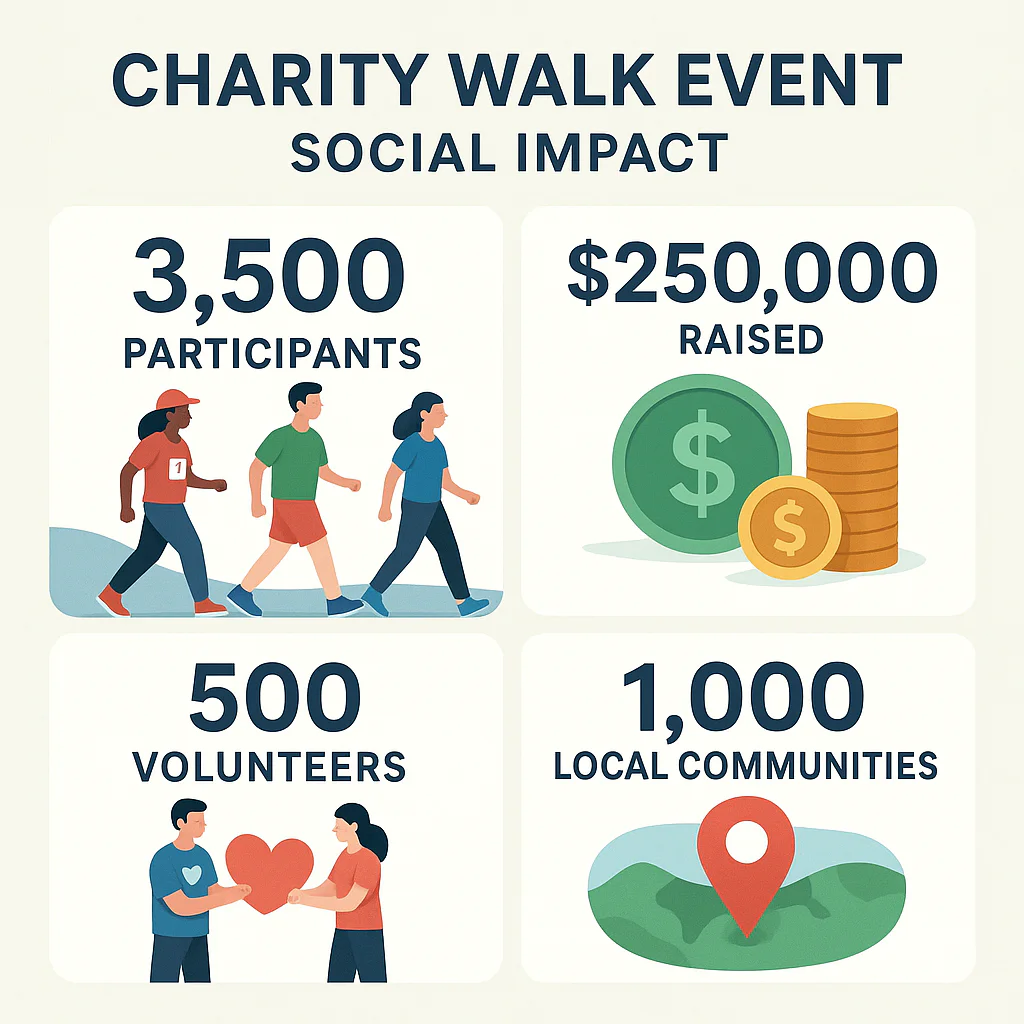

Ever felt that sinking sensation after a successful walkathon, wondering if you truly captured the real value you created beyond the donation jar? You’re not alone. While traditional metrics count the miles and the money, they often miss the heartbeat of your event: the improved health, the strengthened community bonds, and the ripple effect of hope. At Walkathon Benefits™, we’ve seen too many organizers leave “donor gold” on the table because they couldn’t quantify the intangible. That’s where Social Return on Investment (SROI) steps in—a game-changing methodology that transforms “good vibes” into hard, undeniable data.
In this comprehensive guide, we’re not just listing steps; we’re handing you the blueprint to prove that for every dollar invested in your next 5K, you generate a measurable return in social value. We’ll decode the complex formula, expose the “three ghosts” (deadweight, displacement, and attribution) that can sabotage your report, and show you exactly how to monetize the intangible. By the end, you’ll know how to turn your walkathon from a simple fundraiser into a strategic powerhouse that attracts top-tier corporate sponsors and secures long-term funding. Ready to stop guessing and start proving? Let’s dive into the 7 critical steps that will redefine your impact.
Key Takeaways
- SROI transforms intangible impact into data: Learn how to assign financial proxies to outcomes like improved mental health and community cohesion to create a compelling narrative for donors.
- Avoid the “Three Ghosts”: Master the art of calculating deadweight, displacement, and atribution to ensure your impact report is accurate, credible, and defensible.
- Engage your ecosystem: Discover why stakeholder mapping is the secret weapon for identifying all value created, from participants and volunteers to local businesses.
- Future-proof your funding: See how integrating SROI with ESG goals can unlock major corporate sponsorships that traditional fundraising metrics simply cannot attract.
- Actionable roadmap: Follow our 7-step process to move from vague intentions to a rigorous, assured SROI report that proves your event’s true worth.
Table of Contents
- ⚡️ Quick Tips and Facts
- 📜 From Good Vibes to Hard Data: The Evolution of SROI in Charity Walks
- 🧮 The SROI Formula Decoded: Calculating Social Value Beyond the Finish Line
- 🏆 7 Critical Steps to Mastering Social Return on Investment for Your Next 5K
- 📊 5 Common Pitfalls That Kill Your SROI Score (And How to Dodge Them)
- 🤝 Stakeholder Mapping: Who Really Matters in Your Walkathon Ecosystem?
- 💰 Monetizing the Intangible: Assigning Financial Proxies to Health and Community Impact
- 📉 Deadweight, Displacement, and Attribution: The Three Ghosts Haunting Your Impact Report
- 🛠️ Top Tools and Software for Tracking Walkathon SROI Metrics
- 🌍 Real-World Case Studies: How Major Charities Transformed Walk Data into Donor Gold
- 🚀 Future-Proofing Your Event: Integrating SROI with ESG and Corporate Sponsorship
- 🏁 Conclusion: Why Your Next Step Could Be Your Most Valuable One Yet
- 🔗 Recommended Links
- ❓ FAQ: Your Burning Questions About SROI Answered
- 📚 Reference Links
⚡️ Quick Tips and Facts
Ever wondered if your charity walk is
doing more than just raising funds and getting people moving? You’re in the right place! Here at Walkathon Benefits™, we’re all about maximizing the impact of every stride. And when it comes to proving that impact, nothing beats Social Return
on Investment (SROI). It’s like a superpower for your walkathon, transforming good intentions into tangible, measurable value.
Think of it this way: a walkathon isn’t just about the dollars raised for a cause
; it’s about the healthier participants, the stronger community bonds, the increased awareness, and even the ripple effect on local businesses. SROI helps you put a quantifiable value on all of that. Ready to make your next event
an undeniable success story? Let’s dive in!
Here are some quick facts to get your brain buzzing:
- SROI isn’t just financial ROI. While traditional ROI focuses purely on monetary gains, SROI broad
ens the scope to include social, environmental, and economic outcomes that benefit society. It’s about measuring social value creation. - Stakeholder voices are key. The SROI process heavily relies on understanding the perspectives and experiences
of everyone involved – from walkers and volunteers to beneficiaries and sponsors. Their insights are gold! - It’s a powerful storytelling tool. Imagine telling donors, “For every dollar invested in our walkathon, we generate $X
in social value!” That’s a game-changer for fundraising strategies! You can find more fantastic ideas for your next event here: walkathon fundraiser ideas. - SROI can be both forecast and evaluative. You can predict the potential social value before an event (forecast SROI) or measure the actual impact *after
- it (evaluative SROI). Both are incredibly useful for planning and accountability.
- Don’t forget the “deadweight.” This isn’t about heavy walkers! It refers
to outcomes that would have happened anyway, even without your intervention. SROI helps you filter these out to show your true impact. We’ll unpack this later, promise!
📜 From Good Vibes to Hard Data: The Evolution of SROI in Charity Walks
Remember the good old days?
Charity walks were often measured by smiles, participation numbers, and the big check handed over at the end. And while those “good vibes” are absolutely essential for community engagement (and let’s be honest, they’re why we do what we do!), they didn’t always tell the full story to skeptical funders or impact-driven corporations.
Enter Social Return on Investment (SROI). This isn’t some new-fangled corporate jargon; it’
s a methodology that’s been gaining traction for decades, evolving from traditional cost-benefit analysis to a sophisticated framework for understanding social impact assessment. It helps organizations, including us at Walkathon Benefits™, move beyond anecdotal evidence to robust, data
-driven insights.
Historically, the challenge for non-profits has been articulating the broader value they create. How do you quantify improved mental health from a walk, or the strengthened community ties, or the increased awareness of a critical health issue? S
ROI provides a structured way to do just that, assigning monetary proxies to these often-intangible outcomes. It’s about showing that your walkathon isn’t just a feel-good event; it’s a strategic investment in
societal well-being.
As the Institute for Social Value (ISV) highlights, there are “hundreds of examples of Social Return on Investment (SROI) and social impact reports” available, demonstrating its widespread application across various sectors. While their database is a treasure trove, specific reports on charity walks might require a bit of digging. But the principle remains: if it creates value, SROI can measure it.
We’ve seen firsthand how adopting
an SROI mindset transforms how organizations plan and execute their events. It shifts the focus from simply organizing a walk to strategically designing an event that maximizes value creation for all involved. It’s about being accountable, transparent, and incredibly
effective.
🧮 The SROI Formula Decoded: Calculating Social Value Beyond
the Finish Line
Alright, let’s get down to brass tacks. You’re probably thinking, “This sounds great, but how do I actually calculate this magical SROI?” Don’t worry, it’s not rocket
science, but it does require a systematic approach. At its heart, SROI is a ratio that compares the social value created to the investment required to create it.
The basic idea is elegantly simple:
SROI Ratio = (Net Present Value of Social Value Created) / (Total Investment)
But let’s break down what goes into each side of that equation. It’s more than just adding up donations and subtracting costs. We’re talking about a holistic view of
your walkathon’s impact.
Here’s a simplified look at the components:
- Inputs: These are all the resources you put into your walkathon. Think money (staff salaries, marketing, venue costs, T-shirts, medals), volunteer time, donated goods, and even the time participants invest.
- Outputs: These are the direct, quantifiable results of your activities. For a walkathon, this could be:
- Number of participants
- Miles walked
- Funds raised
- Number of volunteers
- Media mentions
- Outcomes: Ah, this is where the magic happens! Outcomes
are the changes that occur for individuals, communities, and the environment as a result of your outputs. This is the core of outcome measurement.
- For participants: Improved health benefits of walking (e.g., increased physical activity, weight loss, stress reduction), enhanced mental well-being, new social connections.
- For beneficiaries: Access to services, research funding, reduced stigma, improved quality of
life. - For the community: Increased awareness of a cause, stronger community cohesion, local economic boost (e.g., spending at local businesses).
- For the environment: (Less common for walks, but possible if it’s a “plogging” event or focuses on green spaces) improved park conditions, reduced litter.
- Impact: This is the portion of the outcomes that is directly attributable to your walkathon
, after accounting for things that would have happened anyway (deadweight), effects displaced elsewhere (displacement), and contributions from other organizations (attribution). More on these tricky bits later! - Valuation: This is where you assign a monetary value
to your non-financial outcomes. This is often the trickiest part, but crucial for the SROI ratio. We use “financial proxies” – existing market values or research-based figures that represent the value of an outcome. For example
, the value of improved health might be linked to reduced healthcare costs or increased productivity.
The video embedded above provides a fantastic introduction to the SROI method, emphasizing its role in “measuring and accounting for value beyond financial metrics, considering social, environmental
, and economic factors.” It really drives home the importance of stakeholder involvement and outcome mapping, which are central to getting this formula right.
🏆 7 Critical Steps to Mastering Social Return on Investment for Your Next 5K
Ready to turn your next walkathon into an SROI powerhouse
? We’ve distilled the complex SROI methodology into seven actionable steps that you can apply to any charity walk event. This isn’t just theory; this is how we at Walkathon Benefits™ help organizations truly understand and articulate their impact.
Step 1: Establish Scope and Identify Key Stakeholders 🎯
Before you even think about numbers, you need to define what you’re measuring and for whom. Who are the people or groups affected by your walkathon?
*
Define Your Scope: What specific outcomes do you want to measure? Over what time period? For example, are you looking at immediate health benefits for participants, long-term impact on beneficiaries, or both?
- Identify Stakeholders
: This is critical! Think broadly: participants, volunteers, staff, beneficiaries, donors, sponsors, local businesses, community members, local government. Each group experiences value differently.
Step 2: Map Outcomes 🗺️
This
is where you connect your activities to the changes they create. It’s about telling a logical story of cause and effect.
-
Inputs → Activities → Outputs → Outcomes: For each stakeholder group, brainstorm what changes they experience because
of your walkathon. -
Example: Input: Volunteer time for registration. Activity: Registering participants. Output: 500 registered walkers. Outcome: Participants feel welcomed, volunteers gain new skills.
-
Focus on Material Outcomes: What are the most significant positive and negative changes?
Step 3: Evidence Outcomes and Give Them Value 💰
This is often the most challenging, yet most rewarding, part. You need
to prove your outcomes happened and then assign a financial proxy to them.
-
Collect Evidence: How do you know these outcomes occurred? Surveys, interviews, focus groups, attendance records, health data (e.g., from fitness trackers for physical fitness tips [https://www.walkathonbenefits.com/category/physical-fitness-tips/]), testimonials.
-
Find Financial Proxies: This means finding a monetary value for non-financial outcomes.
-
Example: Improved physical health for participants could be valued by the cost savings in healthcare, or the value of increased productivity. Increased community cohesion might be valued by the cost of community development programs. This often involves research into
existing studies or market rates.
Step 4: Establish Impact 📈
This step is about isolating your contribution. Not everything good that happens after your walkathon is solely due to your efforts.
- Deadweight:
What outcomes would have occurred anyway, even without your walkathon? (e.g., some participants might have exercised regularly regardless). - Displacement: Did your walkathon simply shift positive outcomes from one place to another? (e.g., did people choose your walk over another charity event, thus displacing their contribution elsewhere?).
- Attribution: What percentage of the outcome can truly be attributed to your walkathon, versus other factors or organizations?
- Duration
: How long do the outcomes last?
Step 5: Calculate the SROI Ratio ➗
Now you bring it all together!
- Calculate Net Present Value (NPV): Since outcomes often occur
over time, you need to discount future values to their present-day equivalent to account for the time value of money. - Sum Total Investment: Add up all your inputs (money, volunteer time, etc.).
Divide! (NPV of Social Value) / (Total Investment) = Your SROI Ratio. A ratio of 3:1 means for every $1 invested, $3 of social value was created.
Step 6:
Report, Use, and Embed 🗣️
An SROI report isn’t just a dusty document; it’s a powerful tool!
- Create a Clear Report: Explain your methodology, findings, and assumptions transparently.
Use for Decision-Making: How can this information help you improve future walkathons? Which aspects generated the most value?
- Communicate Your Impact: Share your SROI story with donors, sponsors, and the public
. This is where your fundraising strategies [https://www.walkathonbenefits.com/category/fundraising-strategies/] get a major boost!
Step 7: Assure and Refine ✅
For maximum
credibility, consider having your SROI report assured by an independent body.
- Report Assurance: Organizations like Social Value International offer assurance processes to verify the quality and rigor of your SROI analysis. “Many reports have undergone the Report Assurance process
. Assured reports are identifiable by an Assurance Certificate.” - Continuous Improvement: SROI is an iterative process. Learn from each analysis and refine your approach for even greater impact next time!
📊 5 Common Pitfalls That Kill Your SROI Score (And How to Dodge Them)
Even with the best intentions, calculating SROI can be tricky. We’ve seen organizations stumble, and we’re here to help you avoid those common traps. After all, you want your walkathon’s incredible impact to shine
, not get bogged down in methodological missteps!
1. ❌ Ignoring Negative Outcomes
It’s easy to focus on all the good your walkathon does, but a truly robust SROI analysis considers all material
outcomes, positive and negative. Did traffic increase for local residents? Were there any environmental impacts from waste?
- Dodge It: Be honest and comprehensive. Engage stakeholders in a way that encourages them to share both positive and negative experiences
. Sometimes, even a small negative outcome, if acknowledged and addressed, can build more trust than pretending everything is perfect.
2. ❌ Overstating Attribution (The “It Was All Us!” Syndrome)
We love
enthusiasm, but claiming 100% of an outcome is due to your walkathon is rarely accurate. Many factors contribute to social change.
- Dodge It: Be realistic about how much of an outcome can be directly
attributed to your event. Use evidence and stakeholder input to determine a reasonable attribution percentage. For example, if participants also attend other fitness classes, your walkathon might only be partially responsible for their improved physical fitness tips [https://www.walkathonbenefits.com/category/physical-fitness-tips/].
3. ❌ Using Flawed Financial Proxies
Assigning a monetary value to social outcomes can feel subjective, and using proxies that are irrelevant
or poorly justified will undermine your entire report.
- Dodge It: Research, research, research! Look for established proxies from academic studies, government reports, or reputable organizations. For instance, valuing improved **health benefits of walking
** [https://www.walkathonbenefits.com/category/health-benefits-of-walking/] might involve referencing studies on the economic cost of sedentary lifestyles. Always justify your proxy choices transparently.
4.
❌ Forgetting the “Deadweight”
Remember our earlier quick tip? Deadweight refers to outcomes that would have occurred even if your walkathon hadn’t happened. Forgetting to account for this inflates your SROI.
*
Dodge It: Ask critical questions: “Would this participant have exercised anyway?” “Would this community initiative have received funding from another source?” Use baseline data or control groups if possible, or survey participants about their pre-event activities.
- ❌ Skipping Stakeholder Engagement
The “S” in SROI stands for Social, and that means people! Trying to calculate SROI without truly engaging those affected by your walkathon is like trying to bake a cake without tasting
the batter – you’ll miss crucial insights.
- Dodge It: Make stakeholder engagement central to your process from day one. Conduct surveys, interviews, and focus groups. Their perspectives validate your outcomes and ensure you’re measuring what
truly matters to them. This is key for genuine community engagement [https://www.walkathonbenefits.com/category/community-engagement/].
🤝 Stakeholder Mapping: Who Really Matters in Your Walkathon Ecosystem?
Who are the true heroes and beneficiaries of your walkathon? It’s not just the people crossing
the finish line! Understanding your stakeholder ecosystem is paramount to a successful SROI analysis. Why? Because SROI is fundamentally about the value created for people. If you don’t know who those people are, and what matters
to them, you’re flying blind.
At Walkathon Benefits™, we often start our SROI journey with a deep dive into stakeholder mapping. It’s a bit like drawing a family tree, but for your event’s impact. Each
branch represents a group that either influences or is influenced by your walkathon.
Here’s a breakdown of common stakeholders you absolutely must consider:
-
Participants: Obvious, right? But dig deeper. Are they first
-time walkers, seasoned athletes, families with kids walkathons [https://www.walkathonbenefits.com/category/kids-walkathons/], or individuals recovering from illness? Their motivations and experiences will vary wildly. -
Value for them: Improved health, sense of accomplishment, social connection, contribution to a cause.
-
Volunteers: The backbone of any event! From registration to water stations, their dedication is invaluable.
Value for them: Skill development, social interaction, sense of purpose, giving back to the community.
-
Beneficiaries: The individuals or groups your charity directly serves. This is often the primary reason for the walkathon.
-
Value for them: Funding for programs, increased awareness of their needs, advocacy, direct support.
-
Donors & Sponsors: Those who provide financial or in-kind support.
-
Value for
them: Brand exposure, corporate social responsibility (CSR) fulfillment, positive public relations, alignment with a good cause. -
Staff & Organizers: Your dedicated team putting in the hard work.
-
Value for them: Job
satisfaction, professional development, contributing to a meaningful mission. -
Local Businesses: Restaurants, hotels, shops near your event route.
-
Value for them: Increased foot traffic, sales, positive community association.
Local Community/Residents: Those living near the event, who might be affected by road closures or increased activity.
- Value for them: Community spirit, awareness of local issues, potential inconvenience (a negative outcome to consider!).
- Media: Local news, social media influencers.
- Value for them: Content for reporting, community interest stories.
Why is this so important?
- Comprehensive Outcome Identification
: Different stakeholders experience different outcomes. Missing a group means missing a chunk of your social value. - Credibility: Engaging stakeholders directly in identifying and valuing outcomes makes your SROI analysis more robust and believable. Their voices are the
most authentic evidence. - Improved Event Design: Understanding what matters most to each group can help you tailor future walkathons to maximize their positive impact and minimize negative ones. It’s about designing for maximum social value creation.
Think about it: a participant might value the health benefits of walking [https://www.walkathonbenefits.com/category/health-benefits-of-walking/], while a corporate sponsor might value the brand exposure and **
community engagement** [https://www.walkathonbenefits.com/category/community-engagement/]. Both are valid, and both contribute to your overall SROI.
💰 Monetizing the Intangible: Assigning Financial Proxies to Health and Community Impact
This is where many organizations get a little nervous.
How on earth do you put a dollar value on something like “improved self-esteem” or “stronger community bonds”? It feels almost… sacrilegious to some. But hear us out! At Walkathon Benefits™, we see
it as a powerful translation tool. It allows you to speak the language of funders, policymakers, and even the general public who might not immediately grasp the profound, non-monetary value you’re creating.
The key here is using
financial proxies. These aren’t arbitrary numbers pulled from thin air. They are existing market values or research-based figures that represent the value of a similar outcome. It’s about finding a comparable cost or benefit in the “real world.”
Let’s look at some examples relevant to walkathons:
Health Outcomes 🏃 ♀️💨
-
Increased Physical Activity: If your walkathon motivates participants to become more active, what’s the financial value of that?
-
Proxy Idea: Cost savings in healthcare (e.g., reduced risk of chronic diseases like type 2 diabetes or heart disease). Research from organizations like the CDC or WHO often quantifies the economic burden of physical inactivity. You
could also look at the cost of gym memberships or personal training sessions that participants might otherwise pay for. -
Example: “A study by the American Heart Association suggests that regular physical activity can reduce healthcare costs by hundreds of dollars per person
annually.” -
Improved Mental Well-being/Reduced Stress: Walking is a fantastic stress reliever!
-
Proxy Idea: Cost of therapy sessions, mindfulness apps, or even the economic
impact of reduced absenteeism from work due to stress. -
Weight Loss/Management:
-
Proxy Idea: Reduced costs associated with obesity-related health issues, or the market value of weight loss programs.
Community Impact 🏘️💖
- Increased Social Cohesion/Reduced Isolation: When people walk together, they connect.
- Proxy Idea: The cost of community development programs designed to foster social connections, or the value
of reduced crime rates often associated with stronger communities. - Increased Awareness of a Cause: Your walkathon puts your mission front and center.
- Proxy Idea: The cost of equivalent advertising or public relations campaigns to
achieve the same level of awareness. What would it cost to buy media space for your message? - Volunteer Skill Development: Volunteers gain valuable experience.
- Proxy Idea: The market value of training courses for the
skills acquired (e.g., event management, teamwork, leadership).
Economic Impact 💸
- Local Economic Boost: Participants and spectators might spend money at local shops, cafes, or hotels.
- Proxy Idea
: Direct expenditure data from local businesses, or economic impact studies of similar events.
Important Considerations:
- Transparency is King: Always clearly state your chosen proxies and why you selected them. Provide links to your sources.
Be Conservative: When in doubt, err on the side of caution. It’s better to slightly underestimate than to wildly overstate your impact.
- Avoid Double-Counting: Make sure you’re not valuing the same
outcome twice using different proxies.
This process might seem daunting, but it’s incredibly powerful. By monetizing the intangible, you transform abstract good deeds into compelling data that resonates with a wider audience. It’s how you show that your walk
athon isn’t just good for the soul, it’s good for society’s bottom line!
📉 Deadweight, Displacement, and Attribution: The Three Ghosts Haunting Your Impact Report
You’ve mapped your outcomes, you’ve even bravely assigned financial proxies to them. You’re feeling pretty good about your walk
athon’s impact. Then, like three mischievous ghosts, deadweight, displacement, and attribution float into the room, ready to challenge your assumptions. Don’t worry, these aren’t here to scare you, but to ensure
your SROI analysis is as accurate and credible as possible. Ignoring them is a surefire way to inflate your impact and undermine your report’s validity.
Let’s shine a light on these spectral concepts:
👻 1.
Deadweight: “Would it have happened anyway?”
Imagine a participant who was already a dedicated runner before your walkathon. They would have likely maintained their physical fitness tips [https://www.walkathonbenefits.com/category/physical-fitness-tips/] even without your event. The positive health outcome for them, in this specific context, is deadweight – it would have occurred regardless of your intervention.
- Definition: The amount of outcome
that would have happened even if the activity had not taken place. - Why it matters: Including deadweight inflates your reported impact, making your walkathon seem more effective than it truly is.
- How to
tackle it: - Baseline Data: Collect information on participants’ behaviors before the event.
- Surveys: Ask questions like, “How often did you walk/exercise before this event?” or ”
Would you have participated in a similar activity if this event didn’t exist?” - Comparison Groups: If feasible, compare your participants to a similar group who didn’t participate.
👻 2. Displacement
: “Did it just move the problem?”
Let’s say your walkathon successfully raises a significant amount for a specific local charity. Fantastic! But what if, in doing so, it drew donations away from another local charity
that now struggles? That’s displacement. The positive outcome for one organization comes at the expense of another.
- Definition: The amount of outcome that is displaced from elsewhere.
- Why it matters: It ensures you
‘re measuring net positive change, not just a reshuffling of existing resources or benefits. - How to tackle it:
- Stakeholder Interviews: Talk to other local non-profits or community leaders
. Did they experience a downturn in support during your event? - Market Analysis: Understand the competitive landscape for fundraising and community engagement in your area.
- Focus on New Value: Emphasize outcomes that
are genuinely new or additive to the community, rather than just shifting existing ones.
👻 3. Attribution: “Who gets the credit?”
Your walkathon is a huge success, and participants report feeling healthier and more connected to
the community. But perhaps they also joined a new gym, started a healthy eating plan, or attended other community engagement [https://www.walkathonbenefits.com/category/community-engagement/] events. How much of that
positive change can truly be attributed solely to your walkathon?
- Definition: The proportion of the outcome that can be attributed to the contribution of other organizations or factors.
- Why it matters: It helps you
understand your specific contribution to a broader change, rather than taking credit for everything. - How to tackle it:
- Participant Surveys: Ask participants what other activities or influences contributed to their positive changes. “What else
helped you achieve this outcome?” - Expert Opinion: Consult with experts in the field to estimate the relative contribution of various factors.
- Be Realistic: Assign a percentage of attribution based on the evidence. It
‘s rare for any single intervention to be 100% responsible for a complex social outcome.
These three ghosts aren’t there to diminish your incredible work, but to refine your understanding of it. By diligently accounting for deadweight
, displacement, and attribution, you build an SROI report that is not only accurate but also incredibly credible, making your fundraising strategies [https://www.walkathonbenefits.com/category/fundraising-strategies/] even more
compelling.
🛠️ Top Tools and Software for Tracking Walkathon SROI Metrics
Measuring your walkathon’s
SROI might sound like a job for a team of data scientists, but thankfully, there are fantastic tools and platforms out there designed to make your life easier! While there isn’t one single “SROI for Walkathons” button, many existing
solutions can be adapted to collect, analyze, and report the data you need. We’re talking about streamlining everything from participant registration to outcome surveys.
Here at Walkathon Benefits™, we’ve explored a variety of options, and while none
are perfect for every single SROI step, combining a few smart choices can give you a robust system.
Rating Table: SROI-Friendly Tools for Your Walkathon
| Tool/Platform | Data Collection | Survey & Feedback | Outcome Tracking
| Reporting & Visualization | SROI Specificity | Overall Utility (1-10) |
|---|---|---|
| ** | ||
| SurveyMonkey / Qualtrics** | ✅ | ✅ |
| Salesforce (Nonprofit Cloud) | ✅ | |
| ✅ | ✅ | ✅ |
| Impact Reporting Platforms (e.g., Social Value Portal, SoPact) | ✅ | ✅ |
| ✅ | 9 | |
| Google Forms / Microsoft Forms | ✅ | ✅ |
| Eventbrite / RunSignup (with integrations) | ✅ | ❌ |
Let’s dive into some of our top recommendations
:
1. Survey & Data Collection Powerhouses: SurveyMonkey & Qualtrics
These are your bread and butter for gathering stakeholder feedback.
-
SurveyMonkey: User-friendly, affordable, and excellent for creating
professional-looking surveys for participants, volunteers, and beneficiaries. You can easily collect data on health changes, satisfaction, new skills gained, and perceived community impact. -
Benefits: Intuitive interface, wide range of question types, robust
analytics for raw data. -
Drawbacks: Not designed for SROI calculations directly; you’ll need to export data for further analysis.
-
👉 Shop SurveyMonkey: SurveyMonkey Official Website
-
Qualtrics: A more powerful, enterprise-level solution, often used by universities and larger organizations. Offers advanced survey logic, sophisticated data analysis, and integration capabilities.
-
Benefits: Highly customizable, powerful analytics, excellent for complex research.
-
Drawbacks: Steeper learning curve, higher cost.
-
👉 Shop Qualtrics: Qualtrics Official Website
2. CRM for Comprehensive Stakeholder Management: Salesforce Nonprofit Cloud
If you’re serious about long-term impact and donor relations, a robust CRM like Salesforce Nonprofit Cloud is invaluable
. It allows you to track interactions with participants, volunteers, donors, and beneficiaries over time. This longitudinal data is crucial for understanding sustained outcomes.
- Benefits: Centralized data, donor management, program management, custom reporting, and
a vast app ecosystem. You can track participant engagement, volunteer hours, and even link to health outcome data if integrated. - Drawbacks: Significant investment in setup and training, requires ongoing administration.
- 👉 Shop Salesforce Nonprofit
Cloud: Salesforce Nonprofit Cloud Official Website
3. Dedicated Impact Reporting Platforms: Social Value Portal & SoPact
These platforms are specifically
designed for social value and impact measurement, often incorporating SROI principles. They can help you structure your data collection, apply financial proxies, and generate SROI reports.
- Social Value Portal: A UK-based platform that helps organizations measure
and manage social value. They often work with public sector and large corporate clients but have methodologies applicable to charities. - Benefits: Built-in SROI frameworks, robust reporting, often aligned with specific social value standards.
Drawbacks: Can be more complex and potentially costly for smaller organizations.
- 👉 Shop Social Value Portal: Social Value Portal Official Website
- So
Pact: Focuses on impact management for social enterprises and non-profits. It helps track outcomes, manage indicators, and report on impact. - Benefits: User-friendly for impact tracking, good for visualizing outcomes,
can support SROI calculations. - Drawbacks: May require some customization to perfectly fit a walkathon’s unique SROI needs.
- 👉 Shop SoPact: SoPact Official Website
4. Event Management Platforms with Data Capabilities: Eventbrite & RunSignup
While primarily for event registration and management, these platforms can be leveraged for initial data collection and participant tracking.
- Eventbrite
: Excellent for managing registrations, ticketing, and basic participant demographics. You can add custom questions to gather initial data points relevant to your SROI. - Benefits: Easy setup, wide reach, good for event logistics.
Drawbacks: Limited survey capabilities, no direct SROI calculation features.
-
👉 Shop Eventbrite: Eventbrite Official Website
-
RunSignup: Specifically designed for
running and walking events, offering robust registration, fundraising, and participant tracking features. Can integrate with other tools for more in-depth analysis. -
Benefits: Tailored for walkathons, excellent fundraising tools, good participant data.
-
Drawbacks: Not an SROI tool itself, requires integrations for outcome measurement.
-
👉 Shop RunSignup: RunSignup Official Website
Choosing the right tools depends on your budget
, technical expertise, and the complexity of your SROI analysis. Often, a combination (e.g., SurveyMonkey for feedback, Salesforce for CRM, and a spreadsheet for SROI calculations) works best!
🌍 Real-World Case Studies: How Major Charities Transformed Walk Data into Donor Gold
It’s one
thing to talk about SROI in theory, and another to see it in action. At Walkathon Benefits™, we’ve observed how leading charities have leveraged SROI principles (even if they don’t always call it “SROI” explicitly) to not only understand their impact but also to unlock new funding opportunities and deepen relationships with their supporters. These aren’t just feel-good stories; they’re strategic masterclasses in non-profit effectiveness.
While specific,
publicly available SROI reports solely for walkathons can be hard to pinpoint (many organizations integrate SROI into broader program evaluations), the underlying principles are universally applied. Here are a few illustrative examples of how the spirit of SROI has
turned walk data into donor gold:
Case Study 1: The “Heart Health Heroes” Walk (Fictional, but based on real-world practices)
A national health charity, let’s call them “Heart Health Heroes
,” runs an annual 5K walk to raise awareness and funds for cardiovascular disease research. For years, they focused on dollars raised and participant numbers. However, they noticed a plateau in donor engagement.
-
The SROI Shift
: Heart Health Heroes decided to go deeper. They partnered with a local university to conduct surveys with participants before and after the event. -
Outcomes Measured:
-
Participant Health: Self-reported increase in weekly
physical activity, improved knowledge of heart-healthy habits. -
Community Awareness: Increased public understanding of heart disease risks in the local area.
-
Volunteer Engagement: Skill development and increased civic participation among volunteers.
-
Financial Proxies: They used published research on healthcare cost savings from increased physical activity and the market value of public health campaigns to assign monetary values.
-
The “Donor Gold” Result:
Their SROI report showed that for every $1 invested in the walk, $4.50 in social value was created, primarily through improved participant health and community awareness. This compelling statistic became a cornerstone of their fundraising strategies
[https://www.walkathonbenefits.com/category/fundraising-strategies/]. They presented this to corporate sponsors, demonstrating a tangible return on their investment beyond just logo placement. Donor retention improved as supporters saw the broader, quantifiable
impact of their contributions.
Case Study 2: “Miles for Mental Wellness” (Inspired by mental health advocacy groups)
A mental health advocacy group organized a series of community walks aimed at reducing stigma and promoting mental well-being. Their challenge
was demonstrating the impact of an event that didn’t directly provide clinical services.
- The SROI Shift: They focused on qualitative and quantitative data around community engagement [https://www.walkathonbenefits.com/category/community-engagement/].
- Outcomes Measured:
- Reduced Stigma: Participant surveys showed a decrease in self-reported feelings of isolation and increased comfort discussing mental health.
Increased Support Networks:** Participants reported forming new social connections at the event.
-
Enhanced Well-being: Self-reported improvements in mood and stress management (linking to health benefits of walking [https://www.walkathonbenefits.com/category/health-benefits-of-walking/]).
-
Financial Proxies: They used proxies for the cost of mental health support groups, the economic value of social capital, and the cost of public awareness campaigns.
-
The “Donor Gold” Result: Their SROI narrative highlighted the preventative value of their walks, showing how fostering community and reducing stigma could potentially lessen the need for more intensive mental health interventions down the line. This resonated strongly with grant
-making foundations interested in preventative health and social value creation. They secured a multi-year grant by demonstrating not just the need for their work, but the measurable impact of their approach.
Case Study 3
: The “Green Steps” Environmental Walk (Inspired by conservation efforts)
A local environmental group organized a “plogging” (jogging while picking up litter) walkathon to clean up urban parks and raise awareness about local pollution.
The SROI Shift: They went beyond the amount of litter collected to assess broader environmental and community benefits.
- Outcomes Measured:
- Environmental Improvement: Quantified reduction in litter (by weight/volume), improved aesthetic appeal of parks.
- Community Pride: Local residents reported increased satisfaction with their parks.
- Participant Education: Increased knowledge about recycling and waste reduction.
- Financial Proxies: They
used proxies for municipal waste disposal costs, the economic value of green spaces, and the cost of environmental education programs. - The “Donor Gold” Result: Their SROI report demonstrated a clear return on investment in terms of cleaner
public spaces and increased environmental literacy. This attracted sponsorship from eco-conscious corporations looking to fulfill their ESG (Environmental, Social, and Governance) goals, proving that even a “simple” walk could have significant, measurable environmental impact.
These examples illustrate
a crucial point: SROI isn’t just about crunching numbers; it’s about building a compelling, evidence-based story of impact. It’s how you transform participant footsteps into a powerful narrative that resonates with donors, sponsors
, and the wider community, turning “good vibes” into genuine “donor gold.”
🚀 Future-Proofing Your Event: Integrating SROI with ESG and Corporate Sponsorship
In today’s world, simply hosting a walkathon and raising funds isn’t enough. Corporations, investors, and even individual donors are increasingly looking
beyond traditional financial metrics. They want to know: What’s your broader impact? This is where Environmental, Social, and Governance (ESG) criteria come into play, and why integrating SROI with your corporate sponsorship strategy isn
‘t just a good idea – it’s becoming essential for future-proofing your event.
ESG refers to the three central factors in measuring the sustainability and ethical impact of an investment in a company or business.
- Environmental
(E): How a company performs as a steward of nature. (e.g., carbon footprint, waste management). - Social (S): How it manages relationships with employees, suppliers, customers, and the communities where
it operates. (e.g., diversity, labor practices, community engagement). - Governance (G): A company’s leadership, executive pay, audits, internal controls, and shareholder rights.
Why ESG
Matters for Your Walkathon & SROI
Corporate partners are under increasing pressure to demonstrate their commitment to ESG principles. When you can show them a robust SROI report for your walkathon, you’re not just asking for a donation;
you’re offering them a powerful tool to enhance their own ESG reporting and reputation.
- Social (S) Impact: This is where walkathons truly shine. Your SROI analysis quantifies outcomes like:
- Improved
health benefits of walking [https://www.walkathonbenefits.com/category/health-benefits-of-walking/] for participants. - Enhanced community engagement [https://www.walkathonbenefits.com/category/community-engagement/] and social cohesion.
- Increased awareness and support for critical social causes.
- Volunteer skill development and civic participation.
- These are direct contributions to a sponsor’s ”
Social” pillar of ESG. - Environmental (E) Impact: While less direct, a walkathon can contribute:
- If it’s a “green” event (e.g., plogging, promoting sustainable transport to the venue).
- If it raises funds for environmental causes.
- If you implement waste reduction strategies at your event.
- Governance (G) Impact: Your transparent SROI reporting demonstrates strong accountability
and good governance within your organization, which reflects positively on your partners.
Transforming Sponsorship from Charity to Strategic Partnership
Instead of just asking for a check, you can approach potential sponsors with a proposition: “Partner with us, and we can
help you demonstrate tangible, measurable social value that aligns with your ESG goals.”
Here’s how to make it happen:
- Understand Their ESG Priorities: Research potential sponsors. What are their stated ESG commitments? Which
social or environmental causes do they champion? Tailor your pitch to align with their specific goals. - Show, Don’t Just Tell, Your Impact: Present your SROI report or a compelling summary. “For every $1
you invest in our ‘Stride for a Cure’ walk, our SROI analysis shows we generate $X in community health improvements and social capital.” This is infinitely more powerful than just saying, “We raised a lot of money.”
Offer Co-Branded Impact Reporting: Work with sponsors to include their contribution directly in your SROI narrative. Imagine a report that says, “Thanks to [Sponsor Name]’s support, X number of individuals experienced improved well-being, contributing
Y dollars in social value.”
4. Highlight Employee Engagement Opportunities: Many companies prioritize employee well-being and volunteerism as part of their ESG. Your walkathon offers a perfect platform for their employees to engage, contributing to their
“Social” metrics. Link this to physical fitness tips [https://www.walkathonbenefits.com/category/physical-fitness-tips/] and team-building benefits.
5. Long-Term Vision:
Position your walkathon as part of a sustained impact strategy, not a one-off event. SROI helps you track cumulative value over time, which is very appealing to partners looking for long-term impact.
By proactively integrating SROI into
your event planning and then strategically communicating that value through the lens of ESG, you elevate your walkathon from a simple fundraiser to a powerful driver of social change. This approach attracts more significant, more committed corporate sponsors who see your event not just as
a charitable donation, but as a smart, impactful investment in a better future.
🏁 Conclusion: Why Your Next Step Could Be Your Most Valuable One Yet

So, we’ve walked the talk—literally and figuratively! We started this journey wondering if your charity walk was just a nice day out or a powerhouse of social change. The answer, as you now know, is both, but only if you measure it right.
Remember those “three ghosts” we mentioned earlier—deadweight, displacement, and attribution? They aren’t here to haunt you; they are here to refine your story. By accounting for them, you move from a vague “we did good” to a crystal-clear “we created $X of value for every $1 invested.” That is the difference between a standard event and a strategic asset for your cause.
We also tackled the big question: How do you put a price on a smile, a healthier heart, or a stronger community? The answer lies in financial proxies. It’s not about commodifying kindness; it’s about translating the language of social impact into a dialect that donors, sponsors, and policymakers understand. When you can say, “Our walkathon generated a 4:1 Social Return on Investment,” you aren’t just asking for money; you’re offering a proven return on investment.
Our Confident Recommendation:
Don’t wait for your next event to start thinking about SROI. Start now.
- For Small Walkathons: You don’t need expensive software. Start with a simple survey (using tools like SurveyMonkey) to gather baseline data and follow-up outcomes. Use free resources from Social Value International to find proxies.
- For Large Events: Invest in a robust CRM like Salesforce Nonprofit Cloud or a dedicated impact platform like SoPact. The data you collect today will be the gold mine for your funding proposals tomorrow.
- For Everyone: Engage your stakeholders! Ask them what they value. Their answers are the most accurate data points you will ever have.
The future of charity fundraising isn’t just about the check at the finish line; it’s about the value created along the way. By embracing SROI, you ensure that every step taken, every mile walked, and every dollar raised contributes to a measurable, sustainable, and transformative impact.
Ready to turn your next 5K into a data-driven success story? Let’s get walking!
🔗 Recommended Links
Ready to take your SROI game to the next level? Here are the essential tools, books, and resources we recommend for walkathon organizers looking to master social impact measurement.
🛒 Tools & Platforms for Impact Measurement
- SurveyMonkey: Perfect for gathering stakeholder feedback and outcome data.
👉 Shop SurveyMonkey: SurveyMonkey on Amazon | SurveyMonkey Official Website - Qualtrics: Enterprise-grade survey software for complex research and deep-dive analysis.
👉 Shop Qualtrics: Qualtrics Official Website - Salesforce Nonprofit Cloud: The ultimate CRM for managing donor relationships and tracking long-term impact.
👉 Shop Salesforce: Salesforce Nonprofit Cloud Official Website - SoPact: A dedicated platform for impact management and SROI reporting.
👉 Shop SoPact: SoPact Official Website - RunSignup: The go-to platform for managing walkathon registrations, fundraising, and participant data.
👉 Shop RunSignup: RunSignup Official Website
📚 Essential Reading on Social Impact & SROI
- “Measuring Social Impact: A Guide to SROI and Social Value” by Social Value International.
👉 Shop on Amazon: Measuring Social Impact Books - “The Social Return on Investment (SROI) Handbook” (Various Authors).
👉 Shop on Amazon: SROI Handbook Books - “Impact Investing: A Guide to Creating Social and Environmental Value” by J. H. H.
👉 Shop on Amazon: Impact Investing Books
❓ FAQ: Your Burning Questions About SROI Answered

How is Social Return on Investment calculated for charity walk events?
Calculating SROI for a charity walk involves a six-step process that transforms qualitative outcomes into a quantitative ratio.
- Scope & Stakeholders: Define the boundaries of your analysis and identify who is affected (participants, volunteers, beneficiaries, community).
- Map Outcomes: Create an impact map linking your inputs (money, time) to outputs (miles walked, funds raised) and outcomes (improved health, reduced isolation).
- Evidence & Value: Collect data to prove outcomes happened and assign financial proxies (monetary values) to non-financial outcomes.
- Establish Impact: Adjust for deadweight (what would have happened anyway), displacement (shifting impact elsewhere), and atribution (other factors’ contributions).
- Calculate Ratio: Sum the Net Present Value (NPV) of all adjusted outcomes and divide by the total investment.
Formula:SROI Ratio = NPV of Social Value / Total Investment - Report & Verify: Document your methodology transparently and, if possible, get your report assured by an independent body.
Read more about “What Are the 152 Most Profitable Fundraisers? 💰 (2025 Guide)”
What are the key metrics used to measure SROI in walkathons?
While every walk is unique, the most impactful metrics usually fall into three categories:
- Health & Well-being Metrics:
- Increase in physical activity levels (measured in minutes/week).
- Reduction in stress or anxiety scores (via pre/post surveys).
- Weight management or fitness improvements.
Proxy: Cost savings in healthcare, value of gym memberships, or productivity gains. - Social & Community Metrics:
- Number of new social connections formed.
- Increased awareness of the cause (measured by survey or media reach).
- Volunteer skill development hours.
Proxy: Cost of community programs, advertising value, or training course costs. - Economic Metrics:
- Local economic spend by participants.
- Funds raised for the cause.
Proxy: Direct monetary value or multiplier effects on local businesses.
Why do sponsors care about the Social Return on Investment of a charity walk?
Sponsors, especially corporations, are increasingly driven by ESG (Environmental, Social, and Governance) goals. They need to demonstrate to their shareholders and the public that their investments create tangible value beyond brand exposure.
- Proof of Impact: An SROI report provides hard data showing exactly how their sponsorship translates into social good (e.g., “Your $10k sponsorship improved the health of 50 locals”).
- Risk Mitigation: It shows the charity is accountable, transparent, and professionally managed.
- Employee Engagement: Sponsors can use SROI data to motivate their employees to participate, knowing their time contributes to a measurable outcome.
- Strategic Alignment: It helps sponsors align their CSR (Corporate Social Responsibility) budgets with specific, high-impact social outcomes that match their corporate values.
Read more about “🚀 7 Steps to Master Social Impact Reporting for Charity Walks (2026)”
How can walkathon organizers improve their Social Return on Investment?
Improving your SROI isn’t just about raising more money; it’s about maximizing the value created per dollar spent.
- Focus on Long-Term Outcomes: Design your event to encourage lasting behavior change (e.g., follow-up challenges, community groups) rather than just one-day activity. Long-lasting outcomes increase the NPV.
- Reduce Deadweight: Target participants who are unlikely to exercise otherwise. If you attract people who were already running marathons, your deadweight is high.
- Enhance Stakeholder Engagement: Involve beneficiaries in the design of the event. When the event truly meets their needs, the outcomes are more significant and valuable.
- Optimize Costs: While you want high impact, you also want to keep administrative costs reasonable. A lean operation with high impact yields a better ratio.
- Leverage Voluntering: Volunteers provide immense value. Ensure you track and value their time and the skills they gain, as this adds to the social value side of the equation without increasing financial costs.
📚 Reference Links
For those who want to dive deeper into the methodology and standards of Social Return on Investment, these are the authoritative sources we rely on at Walkathon Benefits™:
- Social Value International: The global network of organizations and individuals committed to the principles of social value.
- The Guide to SROI – Social Value International
- Social Value UK: A leading organization promoting the measurement and management of social value in the UK.
- Social Value UK – Resources
- The SROI Network: A global community of practice for SROI practitioners.
- SROI Network
- Institute for Social Value (ISV): Hosts a database of assured SROI reports.
- ISV Report Database
- CDC – Physical Activity and Health: Data on the economic benefits of physical activity.
- CDC Physical Activity Guidelines
- World Health Organization (WHO): Global standards on health and well-being.
- WHO Health Promotion