

There is no universally “most profitable” fundraiser. A direct appeal, walkathon, product sale, auction, or gala can each produce strong results in the right setting—and disappoint in the wrong one. The useful comparison is not a vendor’s advertised margin. It is the event’s net proceeds, volunteer load, compliance burden, repeatability, and fit with the organization’s mission and audience.
This guide gives you a calculation method, a comparison worksheet, and a decision process you can reuse with your own numbers. It does not promise a particular return or rank a commercial fundraising product.
Key Takeaways
- Net proceeds matter more than gross receipts: subtract direct costs, transaction fees, and refunds before comparing options.
- Volunteer time is a real constraint: track planning, promotion, fulfillment, setup, cleanup, and follow-up hours.
- Risk changes the answer: permits, insurance, food handling, gaming rules, donor disclosures, and contracts can make a seemingly simple idea harder to run.
- Use your own forecast: donor history, audience size, average gift, participation, and local costs are more useful than a universal margin claim.
- Pilot before scaling: a limited campaign provides evidence about conversion, workload, and repeat participation.
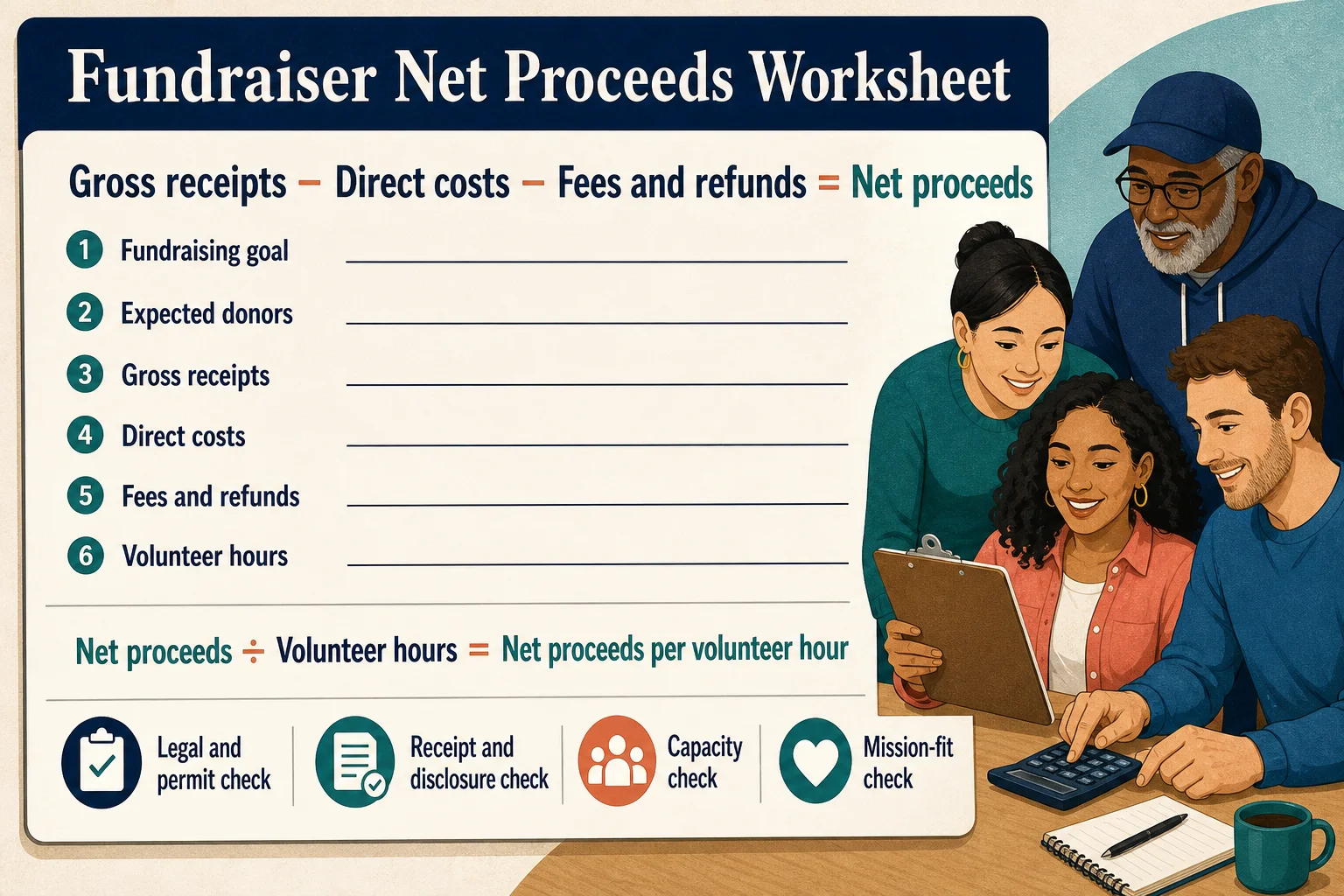
Table of Contents
- Quick answer
- Calculate net proceeds
- Profit margin versus net proceeds
- Compare fundraiser types
- Fundraiser decision matrix
- Worked example
- Compliance and donor checks
- Pilot and measure
- Frequently asked questions
- References
Quick Answer: Which Fundraiser Is Most Profitable?
The most profitable option is the one that produces the best verified result for your organization after costs, fees, refunds, risk, and volunteer capacity are included. Direct asks and peer-to-peer campaigns can have low inventory costs. Walkathons can combine registrations, individual fundraising, and sponsorships but require event operations. Product sales can be easy to explain but add purchasing or fulfillment costs. Auctions and raffles can generate attention but bring valuation, disclosure, and jurisdiction-specific compliance work.
Do not choose from an advertised percentage alone. Build the same forecast for every option and compare the results on equal terms.
Calculate Net Proceeds First
Use this basic calculation:
Gross receipts − direct costs − transaction fees − refunds = net proceeds
Direct costs can include permits, venue or route fees, insurance, equipment, food, printing, merchandise, shipping, entertainment, security, first aid, accessibility accommodations, and contractor payments. Transaction costs may include payment-processing, platform, ticketing, or chargeback fees. Record donated goods separately so the forecast shows both the cash budget and the resources the campaign actually consumes.
Then calculate:
Net proceeds ÷ volunteer hours = net proceeds per volunteer hour
This second measure does not put a price on volunteering. It reveals whether an activity that raises cash also consumes so much capacity that it crowds out programs, donor care, or the next campaign.
Profit Margin Versus Net Proceeds
Margin is useful, but it can be misleading without scale. A small direct appeal might have a high margin and modest total proceeds. A large event might have a lower margin but raise more net dollars, attract new supporters, and deepen community relationships.
Calculate the event margin as:
Net proceeds ÷ gross receipts × 100 = net proceeds margin
Compare at least four results together: net proceeds, margin, volunteer hours, and the number of donors or participants the organization can continue engaging. A campaign with repeatable donor relationships may be more valuable than a one-time sale with slightly higher immediate cash.
Compare Common Fundraiser Types
Direct asks and crowdfunding
These campaigns avoid inventory and venue costs, but they still require a clear case for support, a reachable audience, payment processing, donor acknowledgments, updates, and follow-up. Forecast from the organization’s own list size and prior response—not another campaign’s viral result.
Peer-to-peer campaigns and walkathons
Participants ask their networks to support a cause. A walkathon fundraising plan can combine participant pages, sponsorships, and an in-person or virtual experience. Include route, accessibility, safety, weather, permits, insurance, signage, platform, and event-day costs. Track whether participants become repeat donors or volunteers.
Product sales
Product campaigns can work when buyers understand the offer and volunteers can manage orders. Include wholesale cost, minimum orders, unsold inventory, sales tax where applicable, shipping, storage, damaged goods, refunds, and fulfillment time. Treat a vendor’s quoted margin as an input to verify, not the final result.
Auctions, raffles, and games
Auctions require item sourcing, fair-market-value records, bidder communication, payment, and fulfillment. Raffles and other games can be restricted or regulated by state and local law. Check the rules before promoting or selling entries; do not assume nonprofit status automatically authorizes gaming.
Dinners, galas, concerts, and tournaments
Ticketed events can support major gifts and sponsorships, but venue, catering, production, staffing, weather, cancellation, and accessibility costs can be substantial. Build conservative attendance scenarios and do not count a sponsor until the agreement is signed.
Fundraiser Decision Matrix
| Criterion | Question to answer with evidence |
|---|---|
| Audience fit | Can we identify and reach likely donors, buyers, participants, or sponsors? |
| Cash exposure | How much must be paid before revenue arrives, and who absorbs a shortfall? |
| Net proceeds | What remains under conservative, expected, and strong-response scenarios? |
| Volunteer load | How many planning, promotion, delivery, fulfillment, and follow-up hours are required? |
| Compliance | Which registrations, permits, disclosures, contracts, food rules, gaming rules, or insurance apply? |
| Accessibility | Can donors and participants use the campaign and attend the event without avoidable barriers? |
| Mission fit | Does the activity strengthen the cause, or could it confuse supporters or create reputational risk? |
| Repeatability | Can the organization run it again without exhausting donors, volunteers, or partners? |
Worked Example: Compare With the Same Math
The following numbers are hypothetical and illustrate the method; they are not a benchmark.
- Gross receipts: $8,000
- Direct costs: $1,900
- Fees and refunds: $300
- Net proceeds: $5,800
- Volunteer hours: 145
The campaign’s net proceeds are $5,800, its net proceeds margin is 72.5%, and it produces $40 in net proceeds per volunteer hour. Apply the same assumptions and cost categories to a second option. Then test lower participation, higher costs, and refund scenarios before deciding.
Compliance and Donor Checks
Fundraising rules depend on the organization, activity, and jurisdiction. Verify the organization’s status and who is legally receiving funds. The IRS Tax Exempt Organization Search can help confirm federal status and eligibility information.
Donor receipts and event benefits require care. IRS guidance on substantiation and disclosure explains that special rules apply when a contributor receives goods or services in return and to certain contribution amounts. State charitable-solicitation, raffle, gaming, sales-tax, and event rules can add requirements. Check with the appropriate state and local agencies and qualified advisers before launch.
This article is a planning framework, not legal or tax advice.
What Our Fundraising Team Has Learned
Organizations we work with rarely get their best result from a single product or event. We have seen stronger resilience when a group combines the emotional connection of a walkathon with a lower-labor digital stream or a carefully tested high-margin offer.
When we compare options, we use three practical pillars: relationships with donors and participants, resources required to deliver the campaign, and results measured as net proceeds and mission value—not gross sales alone.
Our recommendation: use the decision matrix above to choose two plausible options, then pilot both with the same net-proceeds worksheet. A discount-card campaign may fit a group seeking faster cash and high margins; a walkathon may fit a group prioritizing long-term participation, health, and community. Some organizations combine them, using the event to build the donor relationship and a later offer to maintain momentum.
From our featured video: fundraising strategist Kara Logan Berlin asks organizations to change their relationship with money and treat fundraising as the work that finances impact. We use that perspective here to keep donor relationships and mission outcomes alongside the margin calculation.
Pilot, Measure, and Improve
- Define the purpose: name the program or expense the fundraiser supports.
- Build three forecasts: conservative, expected, and strong response.
- Assign owners: identify who handles money, contracts, permits, safety, communications, and reconciliation.
- Run a bounded pilot: limit the first audience, product quantity, route, or event capacity.
- Reconcile actuals: compare receipts, costs, fees, refunds, volunteer hours, and donor retention with the forecast.
- Record the decision: scale, revise, repeat, or stop based on evidence.
Frequently Asked Questions
What fundraiser has the highest profit margin?
There is no universal winner. Direct appeals often avoid inventory costs, while events and sales may produce more gross revenue but require more cash and labor. Calculate the margin with your own costs and response assumptions.
Are walkathons profitable fundraisers?
They can produce meaningful net proceeds when participant fundraising, sponsorships, and event costs are planned together. Route operations, accessibility, safety, permits, insurance, platforms, and volunteer time belong in the forecast.
Should we choose the fundraiser with the highest margin?
Not automatically. Consider total net proceeds, workload, compliance, donor experience, mission fit, repeatability, and whether the activity builds relationships the organization can sustain.
Are all donations tax-deductible?
No. Deductibility depends on the recipient and the transaction. Payments that provide goods or services can be treated differently from a pure contribution. Confirm the organization’s status and current IRS requirements, and provide the appropriate disclosures.
How can we compare two fundraising ideas fairly?
Use the same time period, response assumptions, cost categories, fee treatment, refund allowance, and volunteer-hour method. Test the same conservative and expected scenarios for both.